Pryor moved to Salesforce and it zapped their SEO rankings. We got them back.
Pryor Learning has trained more than 3 million organizations over fifty years. When pryor.com moved to Salesforce Commerce Cloud, half of its top-three keywords were gone within a quarter. We ran the Salesforce Commerce Cloud SEO migration recovery, then the ongoing SEO program, then the content that came out of it.
Pryor Learning
Pryor Learning is one of the longest-running corporate training companies in the US: 8,500+ courses across 19 categories, run as live virtual seminars, in-person events, on-demand eLearning and onsite team training, with CEU, CPE, HRCI, SHRM, PDU, NASBA, OSHA and PMI credits, at pryor.com. A catalog that size lives on organic search, the same way our education and training clients do. The move to Salesforce Commerce Cloud made a two-year slide in search authority much worse, fast. SEO migration recovery is exactly what our ecommerce SEO team does.
The migration left two sets of URLs fighting for the same keywords.
We fixed the platform first, then built on it.
Migration recovery
A 100-point audit and a 90-day sprint through sitemaps, robots, redirects, hreflang, templates and permalinks.
Authority rebuilt
Spam links disavowed, press releases picked up by national news sites, referring domains up by half.
Core Web Vitals diagnosed
Monthly benchmarking with the three root causes named and written up for the platform team to ship.
Research for the writers
Keyword clusters, seasonality, competitor audits and a watch list for Pryor's in-house content team.
AI Overview citations
466 citations tracked, 739 gaps mapped, and a plan to win back the ones that were lost.
Thought leadership
A researched and designed white paper, nine posts, and the LinkedIn and sales copy to put them to work.
You’ll know every name on your project.
- 175+ years of combined ecommerce experience.
- Senior developers & designers, dedicated PM & CXM.
- Over a decade together for most of us. Average tenure is nine years.
- 15 people. Lean mean machine.
 Joe M.Founder & CEO
 Max D.CTO
 Marcos A.Senior Project Manager
 Yaro P.Lead Full-Stack Developer
 Bohdan B.Senior Frontend Developer
Rankings recovered. Authority rebuilt.
A recovery is measured by what comes back. These are the numbers from the monthly reports.
Everything we delivered, from the sitemap to the white paper.
All of the technical SEO and all of the organic SEO. Pryor's platform team shipped the code changes we wrote up, and every deliverable below is in Pryor's hands.
Diagnosis100-Point Migration Audit
What we didA technical and content audit of the newly migrated site, checked against the five ways Salesforce Commerce Cloud is known to hurt SEO: duplicate URLs with parameters, soft 404s, bloated front-end code, placeholder titles and index bloat. Every issue was ranked urgent, short-term or long-term.
Why it matteredYou cannot recover from a migration without the full list. Guessing at fixes wastes the window where rankings can still come back.
CrawlSitemap and robots.txt Rebuild
What we didReplaced a chain of sitemaps that marked every URL as updated daily with one dynamic XML sitemap. Rewrote robots.txt to block cart, query-string and duplicate regional paths, and unblocked the image CDN that had been shut out of search.
Why it matteredGoogle was spending its crawl budget on duplicates and junk while the real pages waited.
RedirectsPages Lost in the Migration
What we didFound dozens of high-value URLs that dropped out of Google's index during the move, including the old Fred Pryor landing page that other sites still linked to. Each one got a 301 or was rebuilt. Internal links that pointed at redirects were repointed.
Why it matteredYears of backlinks were landing on 404s. That is authority the new site was not getting credit for.
HreflangDuplicate Regional Site
What we didA /ca copy of the site and mixed hreflang tags were competing with the US pages for the same rankings. We laid out the three options, blocked the duplicate content and checked the result in Search Console.
Why it matteredTwo copies of every page split the ranking signal in half. One version has to win.
On-pageH1s, Titles and Canonicals
What we didTemplates with missing or duplicate H1s, missing title tags, canonical tags pointing at redirects, non-canonical pages in the sitemap and an event schema Google could not read. Fixed directly or handed to the client's platform team as scoped tickets.
Why it matteredEach one is small on its own. Together they decide whether Google trusts the template or skips it.
URLsPermalink Restructure
What we didMoved the site from a /us/ subfolder to the root domain and coordinated the redirect map with the platform team.
Why it matteredA country folder on a mostly US site buried every page one level deeper than its competitors for no reason.
OngoingInternal Link Program
What we didRegular Screaming Frog and Ahrefs crawls for orphan pages, links from the strongest pages to the best-selling courses, and an audit of the top 10 blog posts so blog traffic flows into course pages.
Why it matteredThe blog was pulling in thousands of sessions that never reached a course page. Links are how that traffic turns into revenue.
PlatformParameterised URL Diagnosis
What we didA root-cause audit that traced a sudden keyword drop across every training category page to 149+ indexable duplicate URLs the platform was generating, with canonical tags pointing at the wrong version. We deployed the robots disallow and specified the canonical fix for the platform team.
Why it matteredSeven Excel keywords dropped at once. That is never a content problem. It is architecture, and it needed proof before anyone would touch it.
Structured dataCourse Schema With Ratings
What we didCourse schema with aggregate ratings on the eight most important course pages, plus FAQ and breadcrumb schema where it fit, validated in Google's Rich Results Test and handed over as a developer-ready package.
Why it matteredPryor's courses have real reviews that search engines could not see. Star ratings in the result typically lift click-through by 15 to 30 percent.
PerformanceCore Web Vitals Reports
What we didMonthly benchmarking across the homepage, category and product templates, with the three root causes named: an A/B test loading both variants, blocking third-party scripts and a hero image the browser discovered too late. Between the first and third reports, Total Blocking Time fell 18% and LCP fell 20%, and the cache hit rate went from near zero to 42%.
Why it matteredThe client's platform team owned the code, so our job was to make every fix specific enough to ship. Layout shift was still open when the engagement moved on to content.
AuthorityBacklink Monitoring and Disavow
What we didMonthly review of the backlink profile, with toxic and spam links collected for disavow: about 1,000 in the first pass and 401 more the following quarter.
Why it matteredNew links only count once the junk is cleared out.
AuthorityPress Releases
What we didPress releases for the categories that needed authority most: Microsoft Excel, Management and Leadership, Communication Training, Cybersecurity, Corporate Training and the AI Training Library. Picked up by AP News, Google News, Yahoo and Bing.
Why it matteredLinks from national news domains tell Google that Pryor is a trusted name for the exact topics it sells.
StrategyKeyword and Competitor Research
What we didA monthly research pack: priority keyword clusters by category, a seasonality calendar for the training industry, competitor content audits of SkillPath, AMA, Dale Carnegie and GoSkills, content gap tables and a protocol for watching AI Overviews and featured snippets.
Why it matteredPryor's own writers produce the content. They needed a map that says what to write, when and against whom.
AI searchAI Overview Citation Recovery
What we didA page-by-page plan for three course pages that had lost their AI Overview citation: open with a straight answer, put the credentials above the fold, swap marketing language for specific facts and add a FAQ block with schema. Ready to paste into the CMS.
Why it matteredGoogle cites the page that answers first. All three pages opened with a question or a sales pitch, which the AI cannot use.
ContentWhite Paper and Blog Series
What we didContent pillar mapping, a researched and designed white paper (The New Manager Challenge), nine blog posts each with LinkedIn copy and a sales-team post, a publication brief with schema and metadata for every post, and a sales-enablement guide.
Why it matteredPryor had fifty years of expertise locked in course material. Turning it into assets gives sales something to send and search something to rank.
AlignmentPaid Search Coordination
What we didKeyword alignment between organic and paid, competitor ad analysis and landing page recommendations shared with the client's paid media agency.
Why it matteredBidding on terms you already rank first for is wasted budget. Coordination moves that spend to where organic is still climbing.
Six tools, one program.
Crawl data, search data, analytics and performance labs, all feeding one monthly report and one ticket queue for the platform team.
- PlatformSalesforce Commerce CloudThe site we recovered, and the source of the duplicate URL problem
- SearchGoogle Search ConsoleIndex coverage, re-indexing and real-user Core Web Vitals
- AnalyticsGoogle Analytics 4Organic sessions, engagement and revenue by channel
- ResearchAhrefsKeyword clusters, backlinks and AI Overview citation tracking
- CrawlScreaming FrogSite audits, orphan pages and redirect chains
- PerformancePageSpeed InsightsLab Core Web Vitals with GTmetrix waterfalls
Defence first, then the front foot.
Recovery work has an order. Stop the traffic loss, rebuild the authority, give the writers a map, then go after what the platform itself is holding back.
- Phase 01Stop the bleeding
A 100-point audit of the migrated site, then a 90-day sprint through the urgent list: one sitemap, a clean robots.txt, 301s for every page lost in the move, the duplicate regional site blocked, missing H1s and titles put back, and the site moved from a country subfolder to the root domain.
- Phase 02Rebuild the authority
Monthly backlink monitoring and disavow, press releases picked up by national news sites for the categories that needed trust, Core Web Vitals benchmarking with the root causes named for the platform team, and keyword alignment with the paid media agency.
- Phase 03Make the content work
A keyword and competitor research pack for Pryor's writers, 26 posts republished in a quarter, a researched and designed white paper on the new-manager problem, and nine posts with LinkedIn and sales copy to carry it.
- Phase 04Fix what the platform broke
A root-cause audit that traced the category page drop to duplicate URLs the platform was generating, course schema with ratings on the top course pages, a plan to win back lost AI Overview citations, and rebuilds of the highest-value commercial pages.
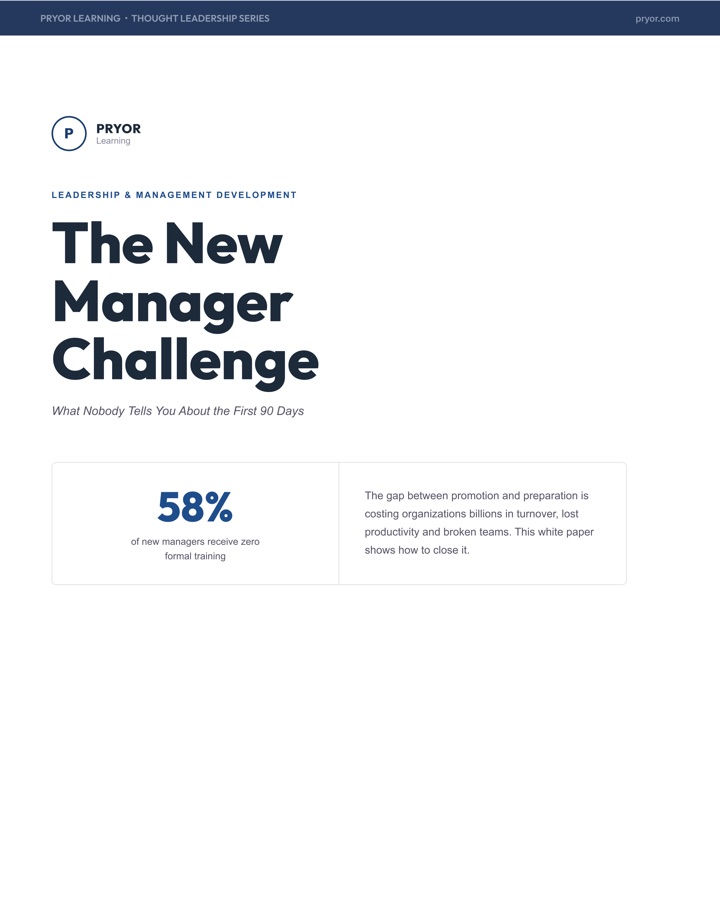
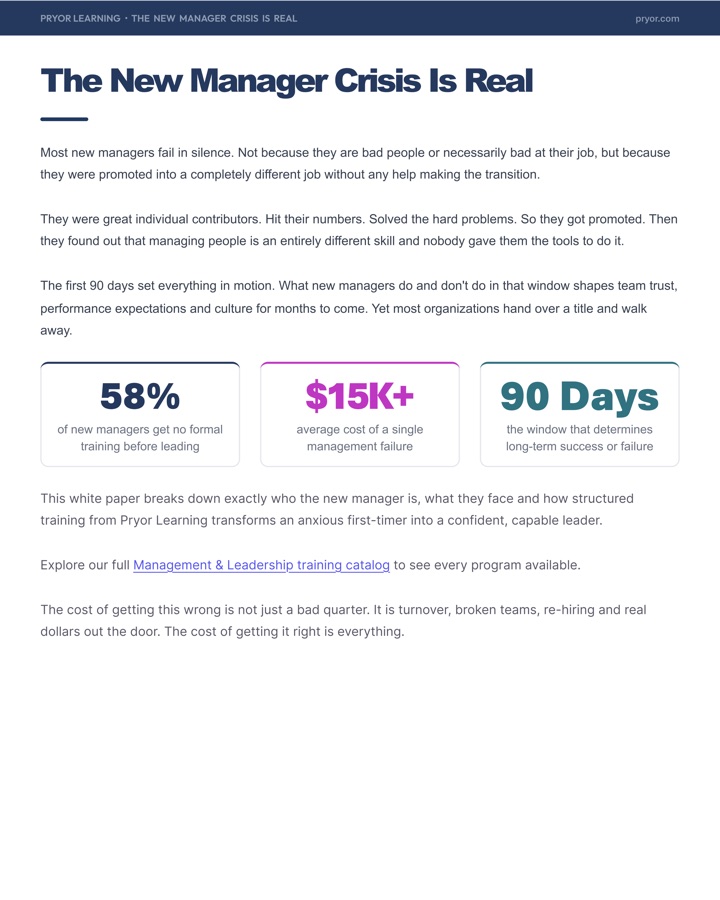
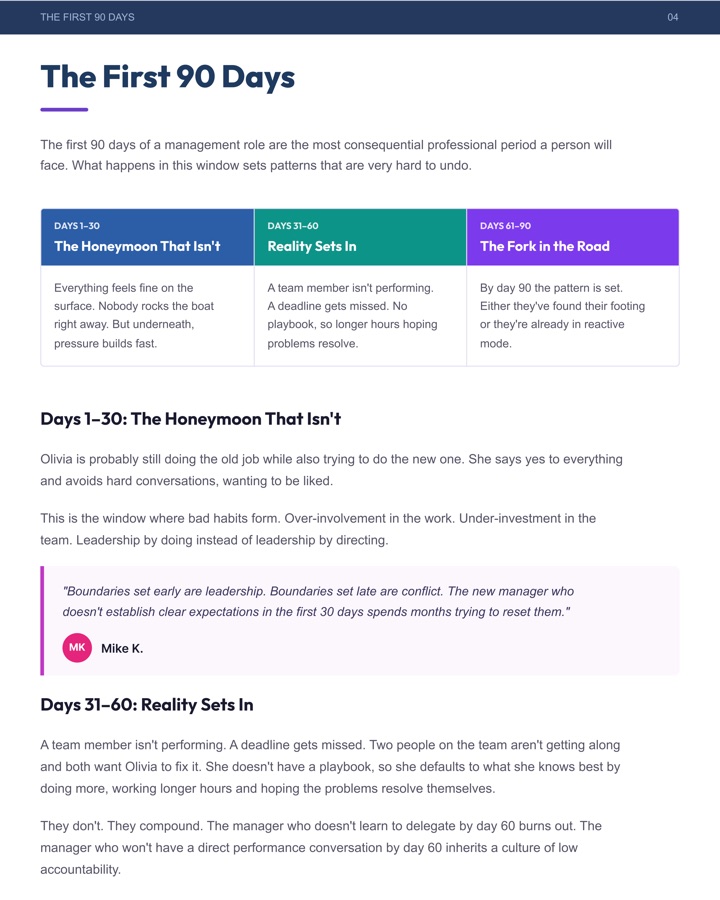
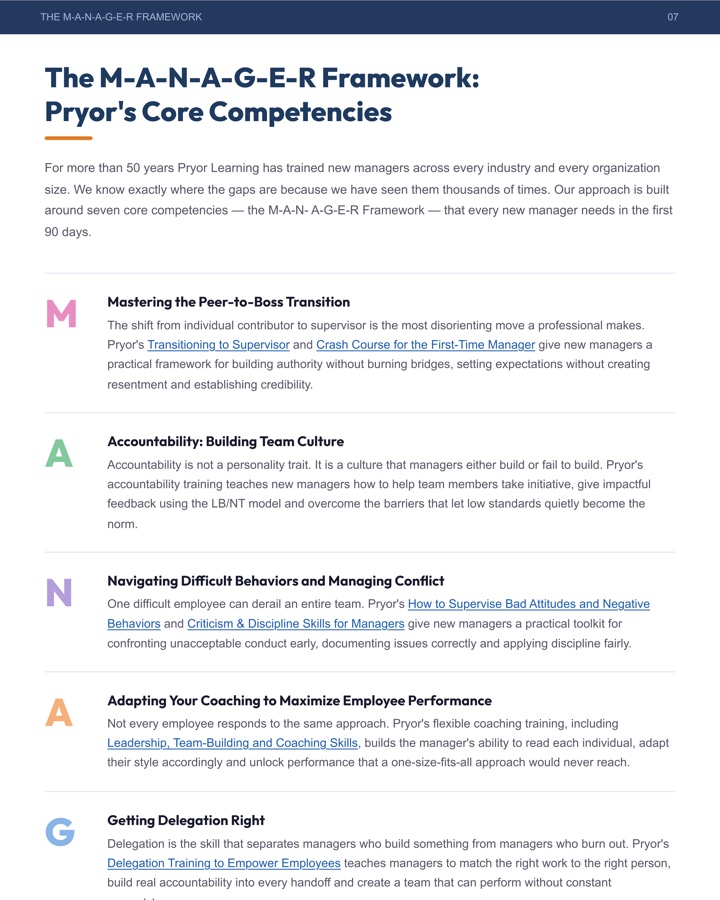
Fifty years of know-how, turned into something sales can send.
Pryor's best material was sitting in course decks and webinars. We mapped the content pillars with their team, picked the one with the clearest buyer pain, and researched, wrote and designed The New Manager Challenge: what nobody tells you about the first 90 days.
- One white paper, nine posts. An anchor post on why great employees make terrible managers, then eight more, each with a publication brief, schema and metadata ready for the CMS.
- Copy for every channel. A LinkedIn post and a sales-team post for each piece, so the content works in outreach, not just on the blog.
- Built for search. Every piece targets the new-manager training cluster, where Pryor's course page already holds position two and an AI Overview citation.
Pryor is back on track,
and earning.
Organic visitors now have the lowest bounce rate and the highest engagement of any channel on pryor.com. Course pages are back on page one, the blog is the biggest source of traffic, and Google names Pryor as the answer. The write-up on our blog walks through the order we fixed things in.
Get this for your storeCourse pages back on page one
The Excel Basics course went from 309 to 1,045 organic visits a month and from position 7 to 4 on its main keyword, within three months. The new-manager course went from 125 to 822 visits and position 3 to 2. Of 474 keywords we tracked, 80% gained traffic.


Lost rankings in a migration?
We audit the whole site, fix what the platform broke, and stay for the program that follows. Tell us what dropped and when.