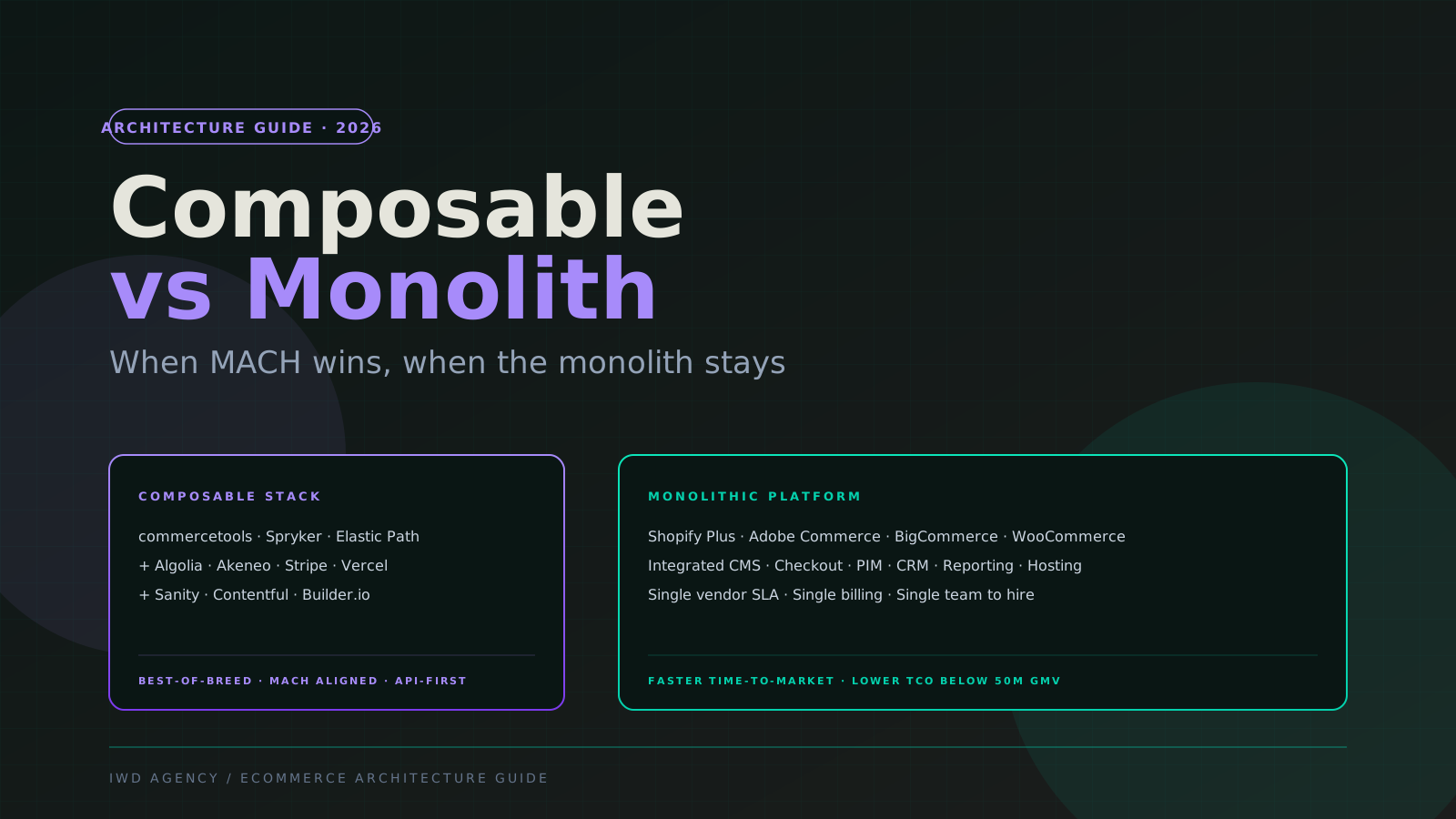
Composable commerce went from enterprise-niche to mid-market mainstream over the last 24 months. Brands previously committed to monolithic platforms (Shopify Plus, Adobe Commerce, BigCommerce, WooCommerce) are now actively evaluating composable stacks built on MACH alliance principles. Other brands are looking at composable architectures, doing the TCO math, and deliberately sticking with their monolith.
This guide is the framework our team uses on every replatform engagement that surfaces the composable question. It's based on builds and consults across both architectures.

The 30-Second Verdict
If you're scanning, here's the short version:
- Composable commerce is the right pick for enterprise brands above 50M GMV with complex requirements that don't fit a monolith well, deep internal engineering teams, and a 12 to 24 month rebuild budget.
- Monolithic platforms (Shopify Plus, Adobe Commerce, BigCommerce, WooCommerce) win for everyone else, including most mid-market brands. Lower TCO, faster time-to-launch, lower team-skill requirements, predictable upgrade paths.
- Hybrid is real and growing. Shopify Plus + headless front-end (Hydrogen or Next.js) + Sanity CMS + Algolia search is essentially composable-lite without the enterprise commerce platform cost.
Below is the full breakdown.
What Composable Commerce Actually Means
Composable commerce is an architecture pattern: instead of one platform that handles catalog + cart + checkout + content + search + customer + orders + everything, you assemble a stack of best-of-breed components connected via APIs.
The MACH alliance defines the principles:
- Microservices: each capability is a separate service with its own scale, deploy, and team
- API-first: every capability exposes APIs as primary interface, not UI
- Cloud-native: services run on cloud-managed infrastructure, not on-prem
- Headless: the storefront is decoupled from back-end capabilities
The result is a stack instead of a platform. Each layer can be replaced independently.
The Composable Commerce Stack (Typical 2026 Setup)
Best-of-breed component stack — typical enterprise composable build
commercetools
Catalog, cart, checkout, orders, customers, B2B. API-first. Most common composable commerce engine for enterprise.
Vue Storefront / Next.js
Front-end framework. Custom React or Vue. Often deployed on Vercel or Netlify with edge caching.
Contentful / Sanity
Editorial content layer. Headless CMS for marketing pages, blog, hero blocks, PLP merchandising copy.
Algolia / Constructor.io
Faceted search, recommendations, merchandising. Sub-100ms search-as-you-type.
Cloudinary / Bynder
Digital asset management. Image transformations, video, brand assets.
Bloomreach / Dynamic Yield
AI-driven personalization, recommendations, A/B testing.
Akeneo / Salsify
Product information management. Catalog enrichment, syndication, channel feeds.
BlueSnap / Bolt
Composable checkout (some brands use commercetools native checkout instead).
NetSuite / SAP S/4HANA
Back-office. Customers, orders, inventory, fulfillment, financial.
That's 9 components in a typical enterprise build. Each one has its own vendor relationship, contract, license, integration, and upgrade cadence.
Composable vs Monolithic: Detailed Comparison
| Dimension | Composable Commerce | Monolithic Platform |
|---|---|---|
| Architecture | 9+ separate vendors, API-connected | 1 platform (Shopify Plus, Adobe Commerce, BC, Woo) |
| Build cost (fresh build) | 500K to 2M+ (12 to 24 weeks) | 75K to 400K (8 to 24 weeks) |
| Annual license cost | 200K to 800K+ (across 9 vendors) | 24K to 250K (one vendor) |
| Annual dev + maintenance | 500K to 2M+ (large in-house team or large agency) | 100K to 500K (smaller in-house + agency) |
| Team skill requirement | High (multiple vendor stacks, custom integration) | Moderate (platform-specific expertise) |
| Time to launch | 12 to 24 weeks (longer for B2B) | 8 to 16 weeks |
| Flexibility | Very high (swap any component independently) | Moderate (constrained by platform model) |
| Upgrade path | Per-component, requires coordination | Platform-managed, scheduled |
| Risk of vendor lock-in | Lower per-component, higher across-stack integration | Higher per-platform |
| SEO control | Total (custom front-end) | Strong (platform varies — BC most, Shopify least) |
| Best for GMV | 50M+ | 1M to 100M (depends on platform) |
The cost delta is the biggest swing variable. Composable builds typically cost 3 to 5x what a monolithic platform costs over a 3-year window when you include build, license, integration, and ongoing dev. That math only works for brands big enough to absorb it and gain meaningful revenue or operational efficiency from the flexibility.
Where Composable Commerce Wins
True multi-brand + multi-region operations
A holding company with 8 brands across 5 regions can't fit cleanly in a monolithic platform. commercetools + Vue Storefront + Contentful gives the brand team isolated component ownership with shared back-office systems. Monolithic platforms force you into multi-store configurations that get awkward at this scale.
Best-of-breed component requirements
If you need Algolia (search), Cloudinary (DAM), Bloomreach (personalization), and Akeneo (PIM) — and your platform of choice doesn't integrate cleanly with all of them — composable solves the integration debt.
API-driven team operations
Engineering teams that already operate on microservices for everything else (marketing automation, CRM, ERP) prefer commerce that fits that pattern. Composable matches existing team operations rather than forcing platform constraints.
Multi-channel orchestration
If you sell through web + mobile app + marketplace + in-store + voice + AI agents, composable lets the catalog + customer + order layer feed all channels through APIs. Monolithic platforms can do this but require more API gluing than composable does natively.
Where Monolithic Platforms Win
Time-to-launch matters
8 to 16 weeks on Shopify Plus or Adobe Commerce vs 12 to 24 weeks on composable. For brands launching new markets, new lines, or pivoting fast, the timeline difference is decisive.
Operational simplicity
One vendor relationship. One upgrade cadence. One support number. Composable replaces this with 9 vendor relationships, 9 upgrade cadences, and ambiguous responsibility when something breaks. For brands without enterprise-grade in-house engineering, this matters a lot.
Lower TCO at sub-50M GMV
The composable math works at enterprise scale. Below 50M GMV, the per-component license costs (commercetools alone runs 100K+ annually) eat the budget that could otherwise fund marketing, product, or operations.
Predictable upgrade path
Monolithic platforms ship version upgrades on a known cadence. Composable upgrades require coordinating across 9 vendors with different release schedules. Brands with smaller in-house teams find composable upgrade coordination operationally painful.
Plus B2B + Hyva = composable-lite already exists
Shopify Plus with native B2B + Hydrogen headless front-end + Sanity CMS + Algolia search is essentially 70 percent of a composable stack at 40 percent of the cost. Adobe Commerce + Hyva theme + Catalog Service for GraphQL reads is similar. These hybrid patterns deliver most of the composable benefit without the full composable cost.
The 5-Question Decision Framework
Five questions to decide composable vs monolith
1. What's your annual GMV trajectory over the next 3 years?
Below 50M GMV growing slowly: Monolithic wins on TCO. Pick Shopify Plus, Adobe Commerce, BigCommerce, or WooCommerce depending on B2B + customisation needs.
50M to 200M GMV with strong growth: Consider hybrid (Shopify Plus or Adobe Commerce + headless + best-of-breed search/CMS).
Above 200M GMV with multi-brand or multi-region: Composable starts to make sense.
2. Do you have enterprise-grade in-house engineering capacity?
Yes (10+ in-house engineers, microservices-experienced): Composable is operationally feasible.
No (small in-house + agency-augmented): Monolithic. Composable will exceed your operational capacity.
3. How many brands or regions do you operate?
1 to 3 brands or regions: Monolithic Multi-Store config covers it.
5+ brands or regions with isolated component ownership: Composable architecture fits.
4. What's your time-to-launch pressure?
Need to launch in under 4 months: Monolithic.
12-24 month rebuild horizon acceptable: Composable is on the table.
5. Are you already running best-of-breed components for search, CMS, DAM, personalization?
Yes (already on Algolia, Contentful, Cloudinary, Bloomreach): Composable removes integration debt.
No (most marketing tools are platform-native): Monolithic platforms are still the simpler operational fit.
Frequently Asked Questions
Is Shopify Plus considered composable commerce?
Not pure composable but the lines are blurring. Plus + Hydrogen headless front-end + Sanity CMS + Algolia search behaves like a composable stack at 40 percent of the cost of pure composable. Shopify is increasingly building API-first capabilities (Functions, Storefront API, Checkout UI Extensions) that make Plus more composable-adjacent.
What's the difference between headless commerce and composable commerce?
Headless commerce decouples front-end from back-end. Composable commerce decouples all the back-end capabilities from each other too. Headless is one component of composable. You can be headless without being composable (Shopify Plus + Hydrogen) or composable without going headless (rare but possible).
Which composable commerce engine should we use?
commercetools is the most common enterprise pick. Spryker, Elastic Path, and BigCommerce Commerce-as-a-Service are alternatives. The decision depends on your B2B needs, multi-channel requirements, and existing enterprise stack. We scope this during discovery.
Does composable commerce work for B2B?
Yes, often very well. commercetools has strong B2B feature support (companies, custom pricing, quote workflows, requisition lists) with API-first flexibility that monolithic platforms can't match. The trade-off is build cost — composable B2B builds run 800K to 3M vs Adobe Commerce B2B at 200K to 500K.
What's the timeline to migrate from monolith to composable?
12 to 24 weeks for a typical mid-market replatform. Larger brands with complex catalog + B2B + multi-region needs run 18 to 36 weeks. The migration itself often costs 2 to 3x more than the original monolithic build because you're not just porting — you're rebuilding the architecture pattern.
Can we go composable incrementally?
Yes — strangler fig pattern. Start by replacing one capability (usually search via Algolia or CMS via Contentful) while keeping the commerce engine monolithic. Add components over 12 to 36 months as the team grows skill. This is the lower-risk path for brands transitioning architectures.
What's the relationship between composable and AI commerce?
Strong. AI commerce features (Sensei AI, ChatGPT shopping agents, Perplexity citations, AI personalization) are easier to integrate into composable architectures because each component exposes APIs that AI engines can call. Monolithic platforms have to bolt on AI; composable architectures can swap in AI-native components.
Related Reading and Service Pages
- Headless commerce development
- Ecommerce development services
- Ecommerce replatforming
- Ecommerce consulting
- B2B ecommerce agency
- AI Search Optimization for eCommerce
- Adobe Commerce Cloud development
We work on both architectures
Our team builds on monolithic platforms (Adobe Commerce, Shopify Plus, BigCommerce, WooCommerce) AND composable stacks (commercetools + Next.js + Sanity + Algolia). The discovery phase produces a written recommendation with rationale, not a pre-determined architecture pitch.
Work with IWD
Not sure which way to go? IWD helps teams decide and build. Explore our headless commerce development, ecommerce replatforming, and ecommerce consultancy.