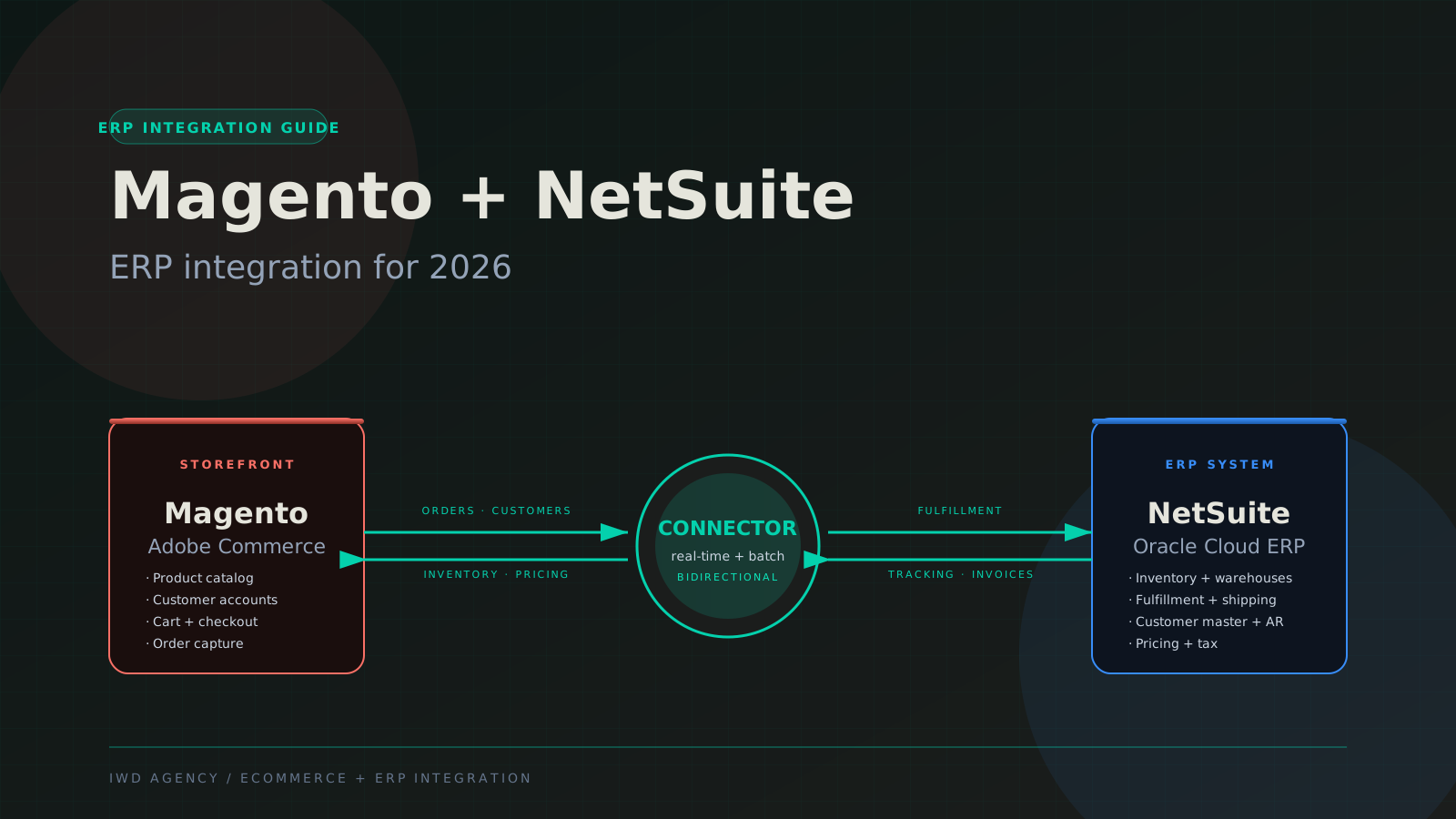
Most Magento and Adobe Commerce engagements above 5M GMV eventually run into the same operational ceiling: the storefront is fine, but the back office isn't keeping up. Inventory shows in-stock when the warehouse is empty. Customer service can't see order status without logging into three systems. Pricing tiers don't propagate to the right customer groups. Fulfillment confirmations lag by hours.
The fix is almost always the same: a real, well-architected integration between the commerce platform and the ERP. For most brands at this scale, that ERP is NetSuite.
This guide is what our team uses to scope, architect, and ship Magento + NetSuite integrations. It covers what actually syncs, the real-time vs batch decision, off-the-shelf vs custom connector tradeoffs, deployment timelines, and the reference architecture we default to in 2026.
The 30-Second Verdict
If you're scanning, here's the short version:
- Off-the-shelf connectors (Celigo, FarApp, Boomi NetSuite SuiteApp) cover 70 to 80 percent of standard B2C use cases and ship in 4 to 8 weeks. Right pick when your business processes are reasonably standard. IWD's own Magento NetSuite connector from Dominate sits in this category with same-day setup.
- Custom connectors are the right call for B2B-heavy workflows, complex pricing tier logic, multi-warehouse fulfillment routing, or industry-specific compliance. 10 to 20 weeks build, but you get exactly the sync model your operations require.
- Real-time sync for inventory and order capture. Batch sync (every 15 to 60 minutes) for customer master, product catalog, and historical reporting. Mixing the two is what production-grade integrations look like.
Below is the full breakdown.
What Actually Syncs Between Magento and NetSuite
The first scoping question on every integration project is "what data flows where." Most teams underestimate the surface area. Here's the typical scope.
Inventory
The single most important sync. NetSuite is the inventory system of record. Magento receives stock levels per SKU per warehouse via real-time push (or near-real-time, sub-5-minute polling). Sub-second inventory sync isn't required for most B2C, but inventory accuracy is. Out-of-stock orders past available stock are the single biggest customer service driver in poorly-integrated stores.
Product catalog
NetSuite holds the canonical SKU, item name, price tiers, weights, dimensions, and item categorization. Magento receives the storefront-relevant subset (title, image, description, attributes, category mapping). Storefront-only fields like SEO metadata, page builder content, and storefront category trees stay in Magento and are not synced back.
Pricing and price tiers
NetSuite holds the customer-group price lists (Wholesale Tier 1, Wholesale Tier 2, Distributor, etc). For B2B stores, this is one of the most critical syncs. A customer logged into Magento sees the right price because the customer is mapped to a NetSuite customer group, and the group's price list flows down to Magento as customer-group-specific catalog prices.
Customer master
Bidirectional. Magento captures new customer accounts and pushes them to NetSuite, where they're enriched with AR/AP terms, billing addresses, sales rep assignment, and customer group. Profile updates can originate from either side, with NetSuite winning conflicts in standard configurations.
Orders
Real-time push from Magento to NetSuite at order placement. NetSuite handles AR, fulfillment routing, and tax recalculation. Failed pushes go to a retry queue with alerting after N retries.
Fulfillment, shipments, and tracking
NetSuite generates fulfillment records and tracking numbers. These push back to Magento as shipment events, which trigger Magento's order status updates and shipment notification emails to customers.
Invoices and credits
NetSuite generates invoices. For B2B Net 30 customers, invoice records often surface in Magento as customer account dashboards (open invoices, outstanding balance, payment status). Credit memos and refunds follow the same return path.
Returns and RMA
RMA can originate from either system depending on the business workflow. Most retail brands originate RMA in Magento (customer-self-service) and flow it to NetSuite. B2B brands often originate RMA in NetSuite (CSR-initiated) and flow it back to Magento for customer visibility.
Real-Time vs Batch: The Architectural Decision
The second-biggest scoping question is sync model. There's no universal right answer. Different data domains have different latency requirements.
Real-time push
Inventory and order capture must be real-time. Inventory because over-selling produces refunds and angry customers. Order capture because NetSuite needs the order to start fulfillment routing and credit-card capture in many configurations.
Real-time on the NetSuite side means SuiteScript event hooks that fire on item save (inventory change) and order save (new order). On the Magento side, it means async observers fired by order placement and inventory mutations. Middleware (RabbitMQ, AWS SQS, or a managed service like Celigo's iPaaS layer) decouples both ends so failures don't cascade.
Batch sync
Customer master, product catalog, and pricing updates do not need real-time fidelity. A customer updating their phone number doesn't need to flow to NetSuite in under a second. A new SKU appearing in NetSuite at 9am doesn't need to be live in Magento at 9:00:01am.
Batch syncs run on cron-scheduled SuiteScript jobs and Magento queue consumers, typically every 15 to 60 minutes depending on the data domain. Bulk REST APIs (SuiteTalk SOAP, REST Web Services, or RESTlets on the NetSuite side; Magento REST and GraphQL APIs on the storefront side) handle the volume.
When to break this pattern
A few edge cases deserve different handling. Flash sales with high inventory velocity may push inventory sync to real-time per-SKU at intra-second cadence. B2B punchout integrations may need pricing recalculations on cart action, not on a 30-minute poll. Discuss with the integration team if your operations have these characteristics.
Off-the-Shelf vs Custom: The Connector Decision
The third architectural question is whether to use a packaged connector or build custom.
Off-the-shelf connectors
Three main vendors compete in this space:
Celigo Magento-NetSuite SmartConnector is the most-deployed solution in the market. Pre-built flows for the standard sync domains (catalog, inventory, customers, orders, fulfillment). iPaaS layer between systems, so middleware is included. 4 to 8 week typical deployment for standard configurations. Annual subscription pricing scales with transaction volume.
FarApp by Celigo (acquired in 2019) targets simpler implementations. Less configurable but faster to deploy. Right for stores with very standard B2C workflows.
Boomi NetSuite SuiteApp is the option for brands already on the Boomi iPaaS platform. Strong if you have other Boomi integrations to leverage shared infrastructure. Heavier-touch deployment than Celigo.
Custom connectors
Right for B2B-heavy workflows, complex pricing logic (multi-tier with conditional rules), multi-warehouse with fulfillment routing rules, industry compliance (FDA, ITAR), or any business process where the off-the-shelf 80% solution doesn't cover the critical 20%. 10 to 20 week build, but you get exactly what your operations require, no ongoing connector subscription fees, and full control over the data model and sync logic.
| Dimension | Off-the-shelf (Celigo) | Custom build |
|---|---|---|
| Deployment time | 4 to 8 weeks | 10 to 20 weeks |
| Upfront cost | Low (configuration only) | High (custom development) |
| Ongoing cost | Annual subscription (10K to 50K) | Maintenance only (1K to 5K monthly) |
| Customization ceiling | Configuration limits apply | Anything you need |
| B2B workflow support | Standard B2B only | Custom quote-to-cash flows |
| Multi-warehouse routing | Basic logic | Any routing algorithm |
| Ongoing flexibility | Vendor roadmap-bound | Full team control |
Hybrid: configure off-the-shelf, customize the gaps
The most common production pattern is hybrid. Start with Celigo for the 80% of standard sync, then layer custom SuiteScript and Magento code for the 20% your operations require. This gives you faster initial deployment with the flexibility to grow into custom logic where it matters.
Our Reference Architecture
This is the architecture we default to on Magento + NetSuite engagements where a custom or hybrid build is the right call.
The middleware layer is the most important piece. Direct point-to-point integrations between Magento and NetSuite work in demos and break in production. A real integration needs durable queueing, deterministic retry logic, dead letter handling, and operational visibility. The middleware is where all of that lives.
For lower-volume implementations (under 5K orders monthly), the middleware can be Celigo's iPaaS or a thin Node.js layer on AWS Lambda. For higher-volume B2B operations with complex routing logic, we typically build the middleware as a containerized Node.js service deployed on AWS ECS or Azure App Service.
Deployment Timeline
A typical Magento + NetSuite integration breaks into five phases:
Phase 1: Discovery (Weeks 1-2)
Workflow mapping (how do orders actually flow today?), data model audit (what fields exist where, with what definitions?), and stakeholder alignment (ops, customer service, IT, finance). Output is a sync surface document listing every domain, direction, and latency requirement.
Phase 2: Architecture (Weeks 2-4)
Connector decision (off-the-shelf vs custom vs hybrid), middleware spec, error handling plan, and acceptance criteria for each sync domain. Output is a technical design document and project plan.
Phase 3: Build (Weeks 4-10)
Iterative implementation. Catalog and inventory first because they're foundational. Orders and fulfillment second because they're the highest-value flows. B2B-specific logic and custom routing last. Each domain ships to a staging environment with synthetic test data before integration tests.
Phase 4: UAT (Weeks 10-13)
End-to-end scenarios with real operations teams. Load testing at projected production volumes. Edge case validation (failed payments, partial fulfillments, returns mid-flow). Stakeholder sign-off per domain before cutover scheduling.
Phase 5: Cutover (Week 14)
Phased go-live. Inventory and catalog first, observed for 24 to 48 hours. Orders second. B2B-specific flows last. 14-day enhanced monitoring with daily standup, dashboards open, and a documented rollback procedure.
Plan the data migration before the cutover, not during
Historical orders, customers, and catalog data must reconcile between systems before go-live. Customer ID mapping (Magento customer ID to NetSuite internal ID), order number cross-references, and SKU normalization should be locked in Phase 2 and executed by end of Phase 3. Teams that defer this hit go-live and discover their customer data doesn't line up.
Common Pitfalls and How to Avoid Them
Pitfall 1: No middleware layer. Direct point-to-point integrations work in demo and break in production the first time a NetSuite outage or rate limit hits. Always have a durable queue between systems.
Pitfall 2: Missing dead letter handling. Failed messages disappear silently. Alerting on dead letter queue depth (with Slack or PagerDuty) is non-negotiable.
Pitfall 3: Over-syncing. Don't sync data you don't need on the storefront. Storefront-only fields (page builder content, SEO metadata, blog) stay in Magento. NetSuite-only fields (chart of accounts, GL detail, vendor data) stay in NetSuite.
Pitfall 4: Customer ID conflicts. Define which system owns the canonical customer ID. NetSuite typically wins, but the mapping table between systems must be maintained explicitly.
Pitfall 5: No load testing. Integration that works fine at 100 orders/day fails at 1000. Synthetic load tests at 2x expected peak volume are part of every responsible deployment.
Pitfall 6: Ignoring inventory reservation. Real-time inventory sync is necessary but not sufficient. Cart inventory reservation (holding stock for 15 minutes while a buyer completes checkout) prevents over-sells during high-velocity sales events. Plan this in the architecture, not after the first over-sell complaint.
What This Actually Costs
Off-the-shelf Celigo deployment: 30K to 80K implementation, 10K to 50K annual subscription. Right for standard B2C with reasonably stock workflows.
Hybrid (Celigo + custom): 60K to 150K initial, 10K to 50K annual subscription, plus 1K to 5K monthly maintenance.
Full custom integration: 120K to 300K initial, 1K to 5K monthly maintenance, no annual subscription.
These ranges are based on 2026 engagement pricing across our recent Magento + NetSuite builds. Variables that move pricing: B2B complexity (quote-to-cash flows, multi-tier pricing), multi-warehouse routing logic, custom compliance requirements (FDA, ITAR, ITAR-equivalent), and number of integrated downstream systems (3PL, EDI partners, BI warehouses).
Frequently Asked Questions
Common questions about Magento NetSuite integration
How long does a Magento NetSuite integration take?
Off-the-shelf Celigo: 4 to 8 weeks. Hybrid (Celigo + custom): 8 to 14 weeks. Full custom: 10 to 20 weeks. Variables: B2B complexity, number of warehouses, compliance requirements, and how clean your existing data model is.
What does NetSuite integration with Magento cost?
Implementation: 30K to 300K depending on connector approach and B2B complexity. Ongoing: 10K to 50K annual subscription (Celigo) plus 1K to 5K monthly maintenance, or 1K to 5K monthly maintenance only for full custom builds.
Do I need real-time inventory sync?
For most B2C: yes. Over-sells are the single biggest customer service driver in poorly-integrated stores. For most B2B: still yes, because B2B customers expect accurate available-to-promise quantities. Real-time in this context typically means sub-5-minute, not sub-second. Sub-second sync is overkill for almost every use case.
Can Celigo handle our B2B workflow?
For standard B2B workflows: yes. Customer-group pricing, Net 30 terms, basic quote-to-cart with NetSuite as the AR backbone. For complex B2B: hybrid. Use Celigo for the 70 percent of standard sync, then layer custom code for the multi-tier pricing rules, fulfillment routing algorithms, or compliance workflows that don't fit Celigo's configuration model.
Should we move off Magento before integrating with NetSuite?
Usually no. Integration scope is decoupled from platform choice. If you replatform from Magento to Shopify Plus, the NetSuite side of the integration changes very little (Shopify Plus has a similar storefront API surface). Plan the integration as a separate work stream from any replatform discussion.
How do we handle multi-warehouse fulfillment routing?
NetSuite owns the routing decision. Magento publishes the order and shipping address. NetSuite's fulfillment routing logic (rule-based, distance-based, or inventory-prioritized) decides which warehouse fulfills. Shipment records flow back to Magento for customer visibility. This pattern works whether you have 2 warehouses or 20.
What happens if NetSuite goes down?
Magento continues taking orders. The middleware queue buffers outbound messages until NetSuite recovers. Inventory levels become stale (last-known-good values are served from Magento's cache) but the storefront stays operational. Dead letter alerting flags any messages that fail their retry budget so they can be reconciled manually.
The Decision Framework
Quick reference: which connector pattern fits your business
Standard B2C, sub-5K orders monthly, no B2B
Off-the-shelf Celigo. 4 to 8 week deployment. Standard flows cover 80%+ of your use case. Skip the custom build cost.
B2C plus light B2B (wholesale tier, Net 30, customer groups)
Hybrid: Celigo + custom for B2B pricing. 8 to 12 weeks. Celigo handles inventory, catalog, orders. Custom code handles tier-pricing logic and B2B-specific data attribution.
Complex B2B with multi-tier pricing, multi-warehouse, custom approval flows
Custom build. 12 to 20 weeks. Off-the-shelf connectors hit their configuration ceiling before they cover your operations. Custom gives you exact-fit at higher upfront cost.
Regulated industry (FDA, ITAR, controlled substances)
Custom build, mandatory. Compliance audit trails, lot tracking, and serialization don't fit packaged connectors. Plan for 16 to 24 weeks including compliance documentation.
Related Reading
Dominate Magento NetSuite connector · NetSuite integration services · Magento B2B agency · Adobe Commerce development · Magento development services · B2B ecommerce agency · Composable commerce vs monolithic
If you're scoping a Magento or Adobe Commerce integration with NetSuite in 2026, book a 30-minute integration scoping call with our team. We'll review your sync surface, recommend a connector approach, and provide a realistic deployment timeline.