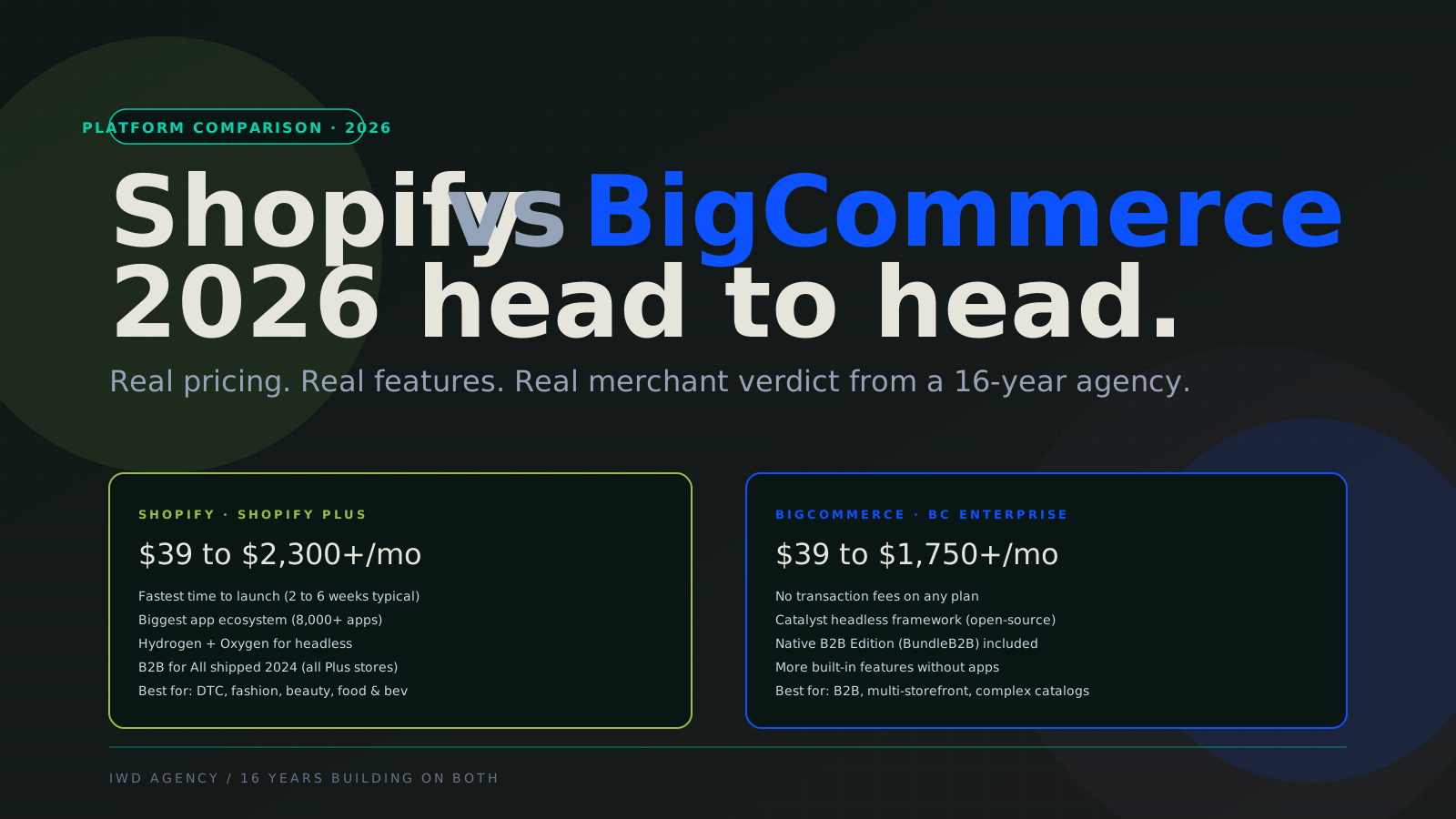
Picking your ecommerce platform is one of the highest-leverage decisions you will make as a brand owner. It locks in your costs, your launch speed, your team's day-to-day, and how easily you can grow into B2B, wholesale, or international without ripping the stack apart.
In 2026, Shopify and BigCommerce are still the two most-considered SaaS platforms for mid-market and enterprise commerce. They have closed most of the historical feature gaps, but the two platforms suit very different businesses. This post is the version of the comparison we wish existed when clients ask us at IWD Agency which one to pick.
We have shipped on both for 16 years. Here is what is actually different in 2026.
At a glance: Shopify vs BigCommerce in 2026
| Dimension | Shopify / Shopify Plus | BigCommerce / Enterprise |
|---|---|---|
| Starting price | $39/mo (Basic) | $39/mo (Standard) |
| Mid-market price | $399/mo (Advanced) | $399/mo (Pro) |
| Enterprise price | From ~$2,300/mo (Plus) | From ~$1,750/mo (Enterprise) |
| Transaction fees on outside gateways | 0.5% to 2% (waived with Shopify Payments) | $0 (none on any plan) |
| App ecosystem | 8,000+ apps | ~1,500 apps |
| Native B2B | B2B for All (all Plus stores, 2024) | B2B Edition / BundleB2B included |
| Headless framework | Hydrogen + Oxygen hosting | Catalyst (open-source, Next.js) |
| Multi-storefront | Markets (region-based) | Multi-Storefront (independent stores) |
| Theme system | Online Store 2.0 sections | Stencil (BC's framework) |
| Average TTL (time-to-launch) | 2 to 6 weeks (small to mid) | 6 to 12 weeks (small to mid) |
| Best fit | DTC, fashion, beauty, food & bev, subscription | B2B, manufacturing, large catalogs, hybrid B2B+B2C |
If you want the punchline first: Shopify is faster to launch and has the bigger ecosystem. BigCommerce is the stronger native B2B and large-catalog story without paying enterprise license fees. Both will run a serious DTC store. The real choice comes down to your business model, not your gut feel for either brand.
Updated pricing in 2026
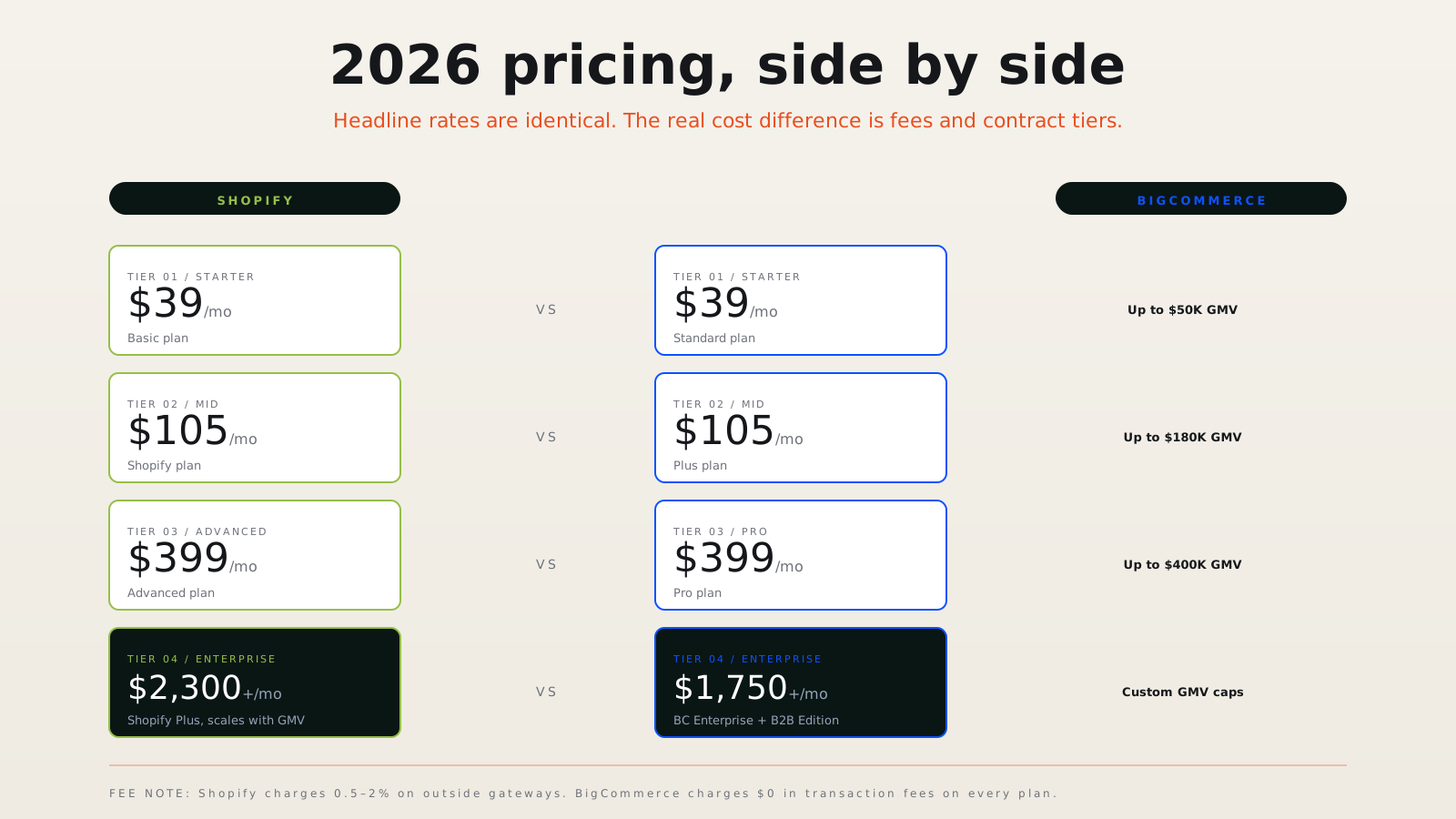
Pricing has shifted considerably since the last time most "Shopify vs BigCommerce" posts were written. Here is the current state.
Shopify pricing (2026)
- Basic — $39/mo (or $29 billed annually). Online store, unlimited products, 2 staff accounts, basic reports.
- Shopify — $105/mo. Professional reports, 5 staff accounts, lower card rates.
- Advanced — $399/mo. Custom report builder, 15 staff accounts, lowest card rates.
- Plus — Starts at ~$2,300/mo for the standard Plus contract, scaling with GMV. Includes 200 POS Pro locations, 9 expansion stores, B2B for All, Shopify Functions, dedicated checkout customizations.
The free Lite plan and the old $9/mo Buy Button plan are no longer the entry point. The lowest tier is the Starter plan at $5/mo, which gives you product pages and links but not a full storefront. Most serious brands start on Basic or higher.
BigCommerce pricing (2026)
- Standard — $39/mo (or $29 billed annually). Up to $50K annual GMV.
- Plus — $105/mo. Up to $180K annual GMV. Abandoned cart recovery, stored credit cards.
- Pro — $399/mo. Up to $400K annual GMV. Custom SSL, Google customer reviews, advanced filtering.
- Enterprise — Custom, starting around $1,750/mo. Higher GMV caps, priority support, B2B Edition, multi-storefront, API rate increases.
The catch on BigCommerce non-Enterprise plans: hit the GMV threshold for the trailing 12 months and you are automatically moved up a tier. Shopify does not have this mechanic.
The other catch on Shopify: any payment processor that is not Shopify Payments incurs a 0.5% to 2% per-transaction fee on top of the gateway's own fees. BigCommerce charges $0 in transaction fees on every plan. At $5M GMV that fee delta is anywhere from $25K to $100K a year, which is real money.
Native B2B: the biggest 2025/2026 shift
If you sell B2B or hybrid B2B+B2C, this section is the most important one in this post.
Shopify B2B for All (rolled out 2024)
Shopify shipped "B2B for All" in 2024, which dropped most B2B features into every Plus store (not just B2B-edition stores). What you get:
- Up to 50 catalogs with custom pricing per company
- Per-company net payment terms (Net 15, Net 30, Net 60, Net 90)
- Quick-order forms, draft order workflows
- Customer-specific product visibility
- Account hierarchies (parent/child buyers)
- B2B checkout with PO numbers
It is genuinely strong for the first time. The gap that remains: deep ERP integration, multi-warehouse fulfillment routing, and very complex tier-pricing logic still need extensions, custom apps, or a connector like our NetSuite to Shopify integration.
BigCommerce B2B Edition (BundleB2B)
BigCommerce's B2B Edition (powered by BundleB2B, which BigCommerce acquired) ships with deeper native B2B out of the box:
- Unlimited price lists with bulk import
- Customer groups with granular visibility and pricing
- Sales rep dashboards with order-on-behalf
- Quote workflows native to the platform
- Shared shopping lists across buyer accounts
- Punchout (cXML) for procurement integration
If your B2B operation is the primary business and you are not on Shopify already, BigCommerce is the better starting point in 2026. The native depth is higher and you do not pay extra for it.
If you are a DTC brand adding a wholesale arm (think a fashion brand opening boutique accounts), Shopify Plus B2B for All is now good enough that you should stay on Shopify rather than rebuild.
Headless and composable: Hydrogen vs Catalyst
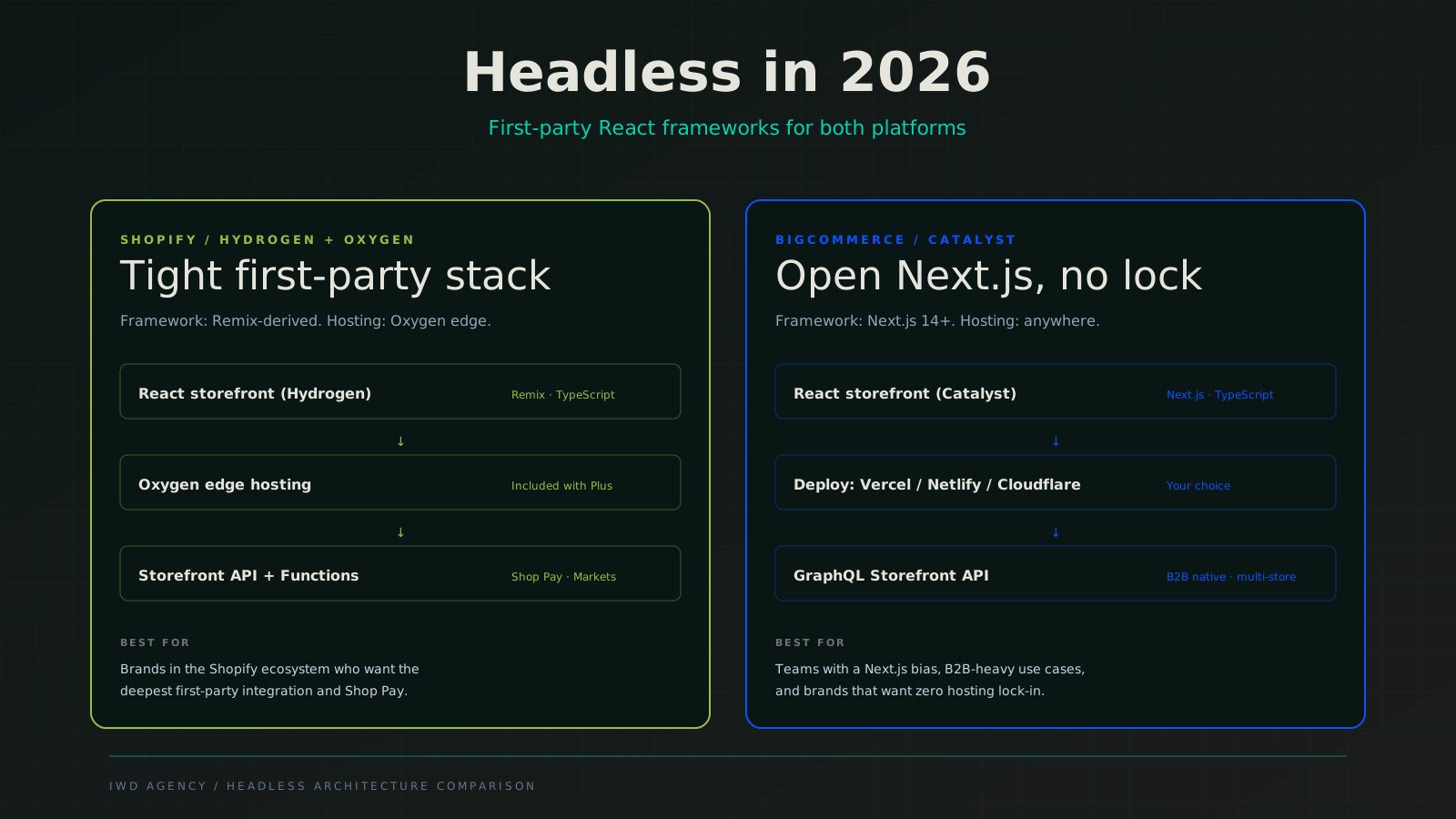
In 2026, "headless" is no longer an exotic choice. Both platforms have first-party React frameworks.
Shopify Hydrogen + Oxygen
- Hydrogen is Shopify's React-based framework (Remix-derived) for building custom storefronts on top of the Storefront API.
- Oxygen is Shopify's edge hosting for Hydrogen sites, included with Plus contracts.
- Tight first-party integration with Shopify Functions, Shop Pay, and customer accounts.
- Tradeoff: you are tied to Shopify's runtime decisions.
BigCommerce Catalyst
- Catalyst is BigCommerce's open-source Next.js storefront framework, launched 2024.
- Runs on Vercel, Netlify, Cloudflare, or your own infra. No vendor lock on hosting.
- Cleaner API surface than Hydrogen for many B2B use cases.
- Tradeoff: smaller community, fewer pre-built components.
If your team has a Next.js bias and wants the lowest lock-in, Catalyst wins. If your priority is the deepest first-party integration and you live in the Shopify ecosystem, Hydrogen wins. We have shipped both. Either is a valid 2026 stack.
Apps and ecosystem
| Ecosystem dimension | Shopify | BigCommerce |
|---|---|---|
| Apps in marketplace | 8,000+ | ~1,500 |
| Free apps available | Many (every category) | Many (every category) |
| Premium themes | 200+ paid + 13 free in OS 2.0 | 100+ paid themes |
| Built-in B2B without apps | Light (apps fill gaps) | Deeper (Edition tier) |
| Built-in product variants | Up to 100 (Plus); 3 options | Unlimited variants |
| Multi-currency | Markets (native) | Native + dynamic pricing |
| Multi-language | Markets (native) | Native |
Shopify has the bigger ecosystem by a factor of about 5x. That cuts both ways. The upside is anything you want exists. The downside is app sprawl (we have seen Plus stores running 40+ paid apps for $4K/mo) and the resulting checkout-page performance hit.
BigCommerce's smaller ecosystem is partially compensated for by more built-in features that do not require apps. Unlimited product variants, multi-storefront, B2B without an additional add-on, etc. Whether that is a feature or a bug depends on whether you like the BC defaults or want to swap them out.
Performance and SEO
Both platforms are on par for technical SEO in 2026, with a few platform-specific notes.
Shopify wins on:
- CDN reach (Cloudflare-backed Shopify CDN is very fast globally)
- Native image optimization (responsive
<picture>with WebP) - Shop Pay checkout (industry-best conversion rate, ~9% lift on average)
- Faster theme cold starts on Online Store 2.0 vs older themes
BigCommerce wins on:
- More flexible URL structure (you can fully control collection/category URLs)
- Better default schema markup (Product, Offer, Aggregate Rating)
- More aggressive lazy-loading defaults
- Native AMP support (still relevant for some markets)
If you are obsessed with Core Web Vitals, both platforms can hit Good ratings on a properly built theme. We see slightly better defaults on BigCommerce and slightly better tooling on Shopify. Implementation matters more than the platform.
For deeper context, our ecommerce platform SEO guide goes through the technical SEO trade-offs in more detail.
Real-world decision framework
After 200+ replatforms and audits, here is the framework we run clients through.
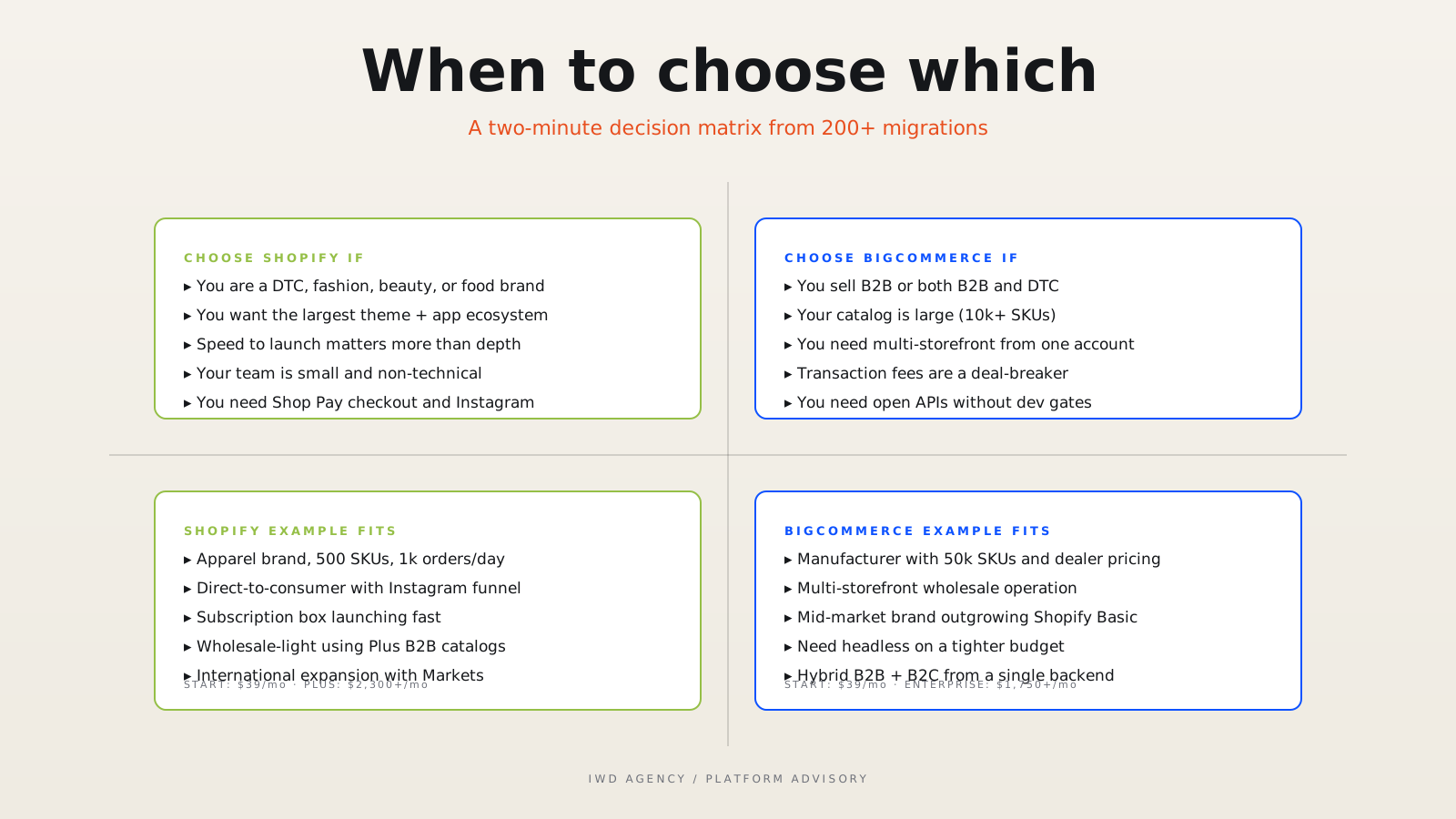
You should pick Shopify if
- DTC is your primary business model. Fashion, beauty, food & bev, subscription, accessories.
- Speed to launch matters. You can be live in 2 to 6 weeks on Shopify with a decent agency.
- You want the biggest app ecosystem. Email, reviews, subscriptions, loyalty, post-purchase, you name it.
- You need Shop Pay. The conversion lift on Shop Pay-eligible traffic is real.
- Your team is small or non-technical. Shopify's admin UX is genuinely better for non-developers.
- You sell on Instagram, TikTok, or Meta. Native commerce integrations are stronger on Shopify.
You should pick BigCommerce if
- You sell B2B or B2B + DTC. BC's native B2B Edition is the better out-of-the-box experience for most B2B operators.
- Your catalog is large (10,000+ SKUs with deep variants). BigCommerce handles complex catalogs more gracefully.
- You need multi-storefront. Two or more independent brand storefronts on one backend. BC's Multi-Storefront is more flexible.
- You hate transaction fees. $0 on every plan vs Shopify's 0.5% to 2% on outside gateways.
- You want open APIs without paywalls. BC's APIs are more open and rate limits are higher on Enterprise.
- You are a manufacturer or distributor. Dealer portals, quote workflows, and ERP integration are smoother.
Common pitfalls we see
After running 200+ replatforming projects, these are the regrets we hear most often.
Brands who picked Shopify and regretted it:
- Heavy B2B operators who underestimated the gap between Plus B2B for All and a true B2B platform.
- Manufacturers with 50K+ SKUs who hit the variant limit and got stuck.
- Brands needing fully independent regional storefronts who outgrew Markets.
Brands who picked BigCommerce and regretted it:
- DTC brands who needed a niche app (a specific subscription tool, a niche review platform) that only existed on Shopify.
- Brands building a TikTok or Instagram-first social commerce strategy.
- Small teams with no dev resources who underestimated BC's developer-leaning UX.
The pattern: the platform problems show up at scale, not on day one. Pick for where your business will be in 24 months, not for where it is today.
Migration considerations
If you are already on one platform and considering the other, the migration is a real project, not a weekend exercise.
A serious replatform from Shopify to BigCommerce (or vice versa) typically costs:
- $40K to $80K for a mid-market brand (1k to 10k SKUs, 1 storefront)
- $120K to $350K for an enterprise B2B replatform with ERP integration
- 6 to 14 weeks of build time before traffic cutover
The catalog migration alone is not the hard part. The hard parts are:
- Customer account migration (passwords cannot be migrated; you trigger a password reset on launch)
- Order history (a one-time export, then read-only on the old platform)
- Checkout customizations (every line of custom code rewritten for the new platform)
- ERP and 3PL integrations (every connector rewritten)
- SEO continuity (301 redirect map for every product, collection, and content URL)
If you are seriously evaluating a migration, our Shopify Plus migration guide and the BigCommerce agency landing page walk through the process in detail. We also offer a free platform audit if you want a real opinion on your specific situation.
Frequently asked questions
Is Shopify or BigCommerce cheaper?
The headline pricing is nearly identical at $39/mo, $105/mo, and $399/mo. The real cost difference shows up two places. First, BigCommerce charges no transaction fees, while Shopify charges 0.5% to 2% on any non-Shopify-Payments gateway. Second, Shopify Plus starts around $2,300/mo while BigCommerce Enterprise starts around $1,750/mo. For a brand doing $5M+ GMV with outside gateways, BigCommerce is typically $30K to $80K/year cheaper in total cost of ownership.
Which platform is better for B2B?
In 2026, BigCommerce B2B Edition is the deeper native B2B platform for operators whose primary business is B2B. Shopify B2B for All (shipped 2024 on all Plus stores) is now good enough for DTC brands adding a wholesale arm or hybrid B2B+B2C operations. If B2B is your primary business, start on BigCommerce. If DTC is primary and B2B is secondary, stay on Shopify Plus.
Which platform is better for headless commerce?
Both have first-party React frameworks. Shopify has Hydrogen (Remix-based) with Oxygen edge hosting. BigCommerce has Catalyst (Next.js, open-source, deploy anywhere). Hydrogen wins on first-party integration depth. Catalyst wins on lock-in and hosting flexibility. Both are production-ready.
Can I migrate between Shopify and BigCommerce?
Yes, in either direction. A typical mid-market migration runs 6 to 14 weeks and costs $40K to $350K depending on B2B complexity and integrations. The catalog and content migration are the easy parts. Customer accounts, order history continuity, ERP integration, and SEO redirect maps are where most projects underestimate effort.
Does Shopify still have the 100-variant limit?
Shopify Plus stores have an increased variant limit of 2,000 per product (up from 100 on lower tiers). BigCommerce has no variant cap. For most catalogs this no longer matters, but for configurable products with many dimensions (think industrial parts) it can still be a blocker on Shopify.
Which platform has better SEO?
Both are excellent in 2026. BigCommerce has slightly more flexible URL control and better default schema markup. Shopify has a faster global CDN and stronger image optimization defaults. Implementation quality matters more than platform choice. See our ecommerce SEO platform guide for the deeper comparison.
Get a real answer for your business
If you are still weighing the two, we can short-circuit the research with a real opinion based on your specific business model, catalog size, B2B mix, integration requirements, and budget. No sales gauntlet. Just a senior strategist who has built on both for 16 years.
Book a free platform audit with IWD →