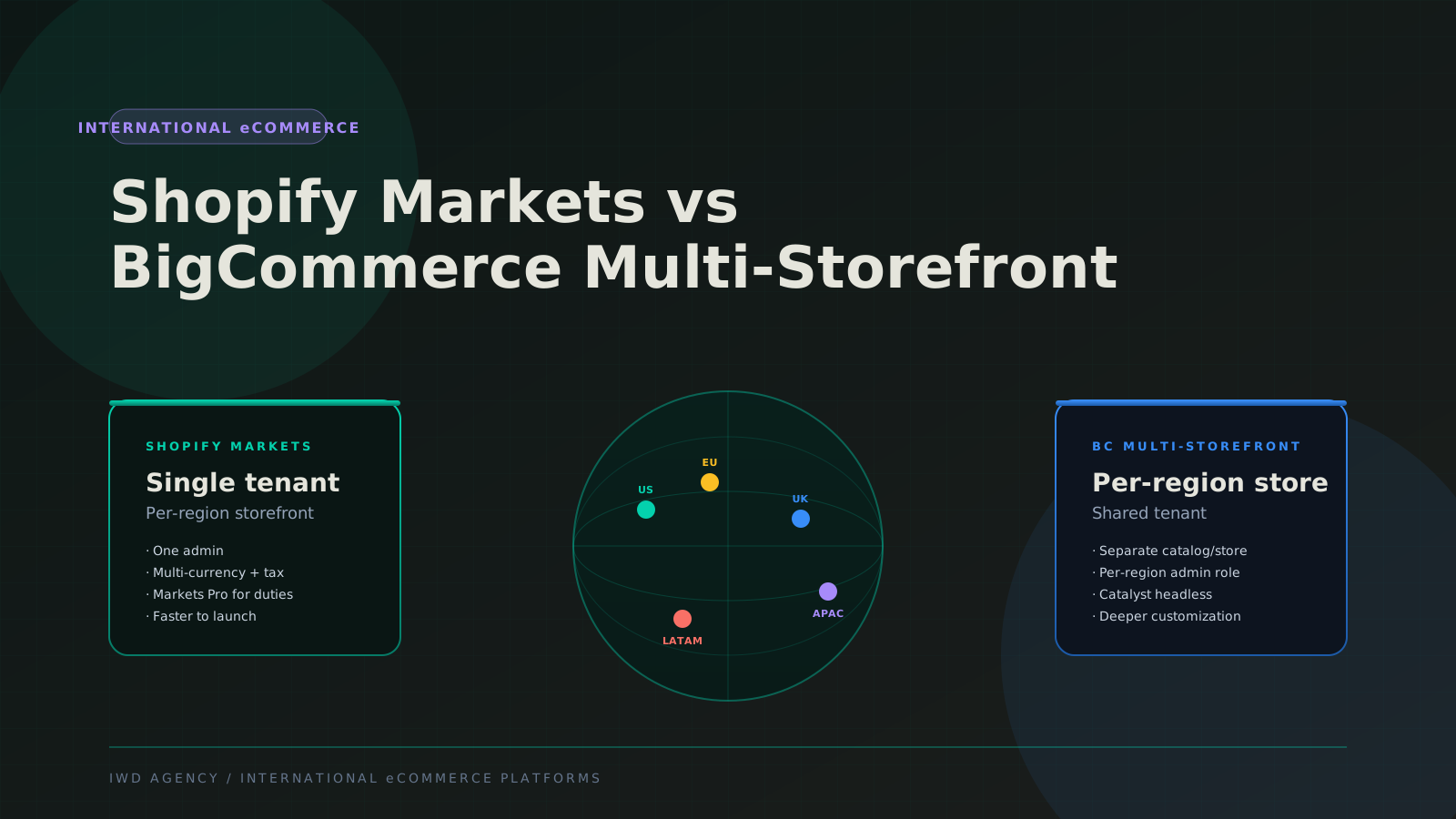
Both Shopify Plus and BigCommerce ship native international ecommerce features in 2026. Shopify Markets and BigCommerce Multi-Storefront solve the same underlying problem (selling to multiple regions with localized pricing, currency, language, and tax) but make different architectural choices.
The decision matters because the architecture you pick shapes everything downstream: catalog management, fulfillment routing, SEO structure, marketing automation, ERP integration, and the operational team you need to run international. This guide breaks down the two approaches side-by-side with the decision framework our team uses on international expansion engagements.
The 30-Second Verdict
If you're scanning:
- Shopify Markets wins for faster international launch (4 to 8 weeks), unified catalog operations, simpler ops teams, and brands with reasonably standard products across regions. Single-tenant model.
- BigCommerce Multi-Storefront wins for brands needing per-region product catalog differentiation, separate B2B and DTC regional channels, deep regional customization, and tighter integration with regional ERP or fulfillment systems. Per-region store model.
- Markets Pro adds Shopify-managed duties + tax compliance for shipping into 150+ countries. Compelling for cross-border DTC.
- Catalyst headless on BigCommerce is the modern customization path. Per-region storefront customization at the React level.
The Architectural Difference
The single most important difference is how each platform models "regional storefront."
Shopify Markets keeps one storefront tenant with regional "Market" views layered on top. Same catalog, same admin, same operational team, with regional differences applied as overlays (currency conversion, language translation, tax rules, regional payment methods).
BigCommerce Multi-Storefront keeps one shared account with multiple separate Storefronts under it. Each Storefront can have its own catalog, theme, checkout, currency, language, and admin roles. The shared layer is the catalog backbone, product master data, and the cross-store admin.
The difference isn't subtle. It changes how you operate, how you customize, and how you integrate with downstream systems.
Side-by-Side Feature Comparison
| Capability | Shopify Markets | BigCommerce Multi-Storefront |
|---|---|---|
| Architectural model | Single tenant, per-region views | Shared tenant, per-region stores |
| Catalog model | Same catalog all markets, region overrides | Per-store catalog, optionally shared |
| Pricing | Per-market currency + adjustment rules | Per-store currency + customer-group pricing |
| Languages | Built-in localization, multiple per Market | Per-store language + Shopper Languages API |
| Domain structure | Subfolder default (/en-uk/), subdomain optional | Subdomain default, custom domain per store |
| Tax + duties | Markets Pro (Shopify-managed) | Avalara, TaxJar, or self-managed |
| Checkout | Shared (per-market localized) | Per-store checkout |
| Payment methods | Per-Market region rules | Per-store gateway config |
| Fulfillment routing | Locations + Markets, single inventory pool | Per-store inventory or shared via Channels API |
| Storefront customization | Liquid theme + Hydrogen headless | Stencil theme + Catalyst headless |
| Admin roles | Cross-Market unified roles | Per-store role granularity |
| B2B integration | Shopify Plus B2B per-Market | BigCommerce B2B Edition per-store |
| Time to launch | 4 to 10 weeks typical | 8 to 16 weeks typical |
| Operational complexity | Lower (one admin) | Higher (per-store ops) |
Domain Structure: The SEO-Critical Decision
Both platforms support multiple domain structures for international stores. The right choice depends on your SEO strategy, brand model, and operational preferences.
Country-code TLDs (brand.com, brand.co.uk, brand.de) give the strongest geo-targeting signal to Google and best per-region brand trust, but link equity doesn't share between them, and operational cost is highest because each is effectively a separate site. Standard pattern in EU and UK retail.
Subdomains (us.brand.com, uk.brand.com) split the difference. Clear geo-separation, partial link equity sharing, easier per-region analytics. BigCommerce Multi-Storefront's default model. Less SEO power than ccTLD but more operational simplicity.
Subfolders (brand.com/en-us/, brand.com/en-uk/) concentrate all link equity at the root domain, lowest operational cost, simplest hreflang configuration. Shopify Markets default model. Weaker geo-targeting signal but typically wins on SEO for new international brands that don't yet have per-region link profiles.
Hreflang configuration is critical regardless of which structure you pick. Google needs the explicit hreflang annotations to map your regional storefronts to the right search audiences.
Tax and Duties: Markets Pro vs Avalara
Cross-border DTC has a real tax and duties problem. Customers shipping internationally don't want to pay surprise duties at the door. Brands don't want to absorb the duty cost themselves. The platforms solve this differently.
Shopify Markets Pro is Shopify's managed solution. Shopify acts as the merchant of record for international transactions, handles VAT/GST/duties calculation at checkout, ships landed-cost-quoted orders, and handles customs paperwork via partner carriers. Available for shipping into 150+ countries. Premium pricing on the Markets Pro service, but the operational simplification is real.
BigCommerce's approach is bring-your-own. Integrate Avalara, TaxJar, or another tax engine for calculation. Integrate Zonos, FlavorCloud, or another duties calculator for cross-border. Or build it yourself via custom Channel API code. More flexibility but more integration work.
For brands with significant cross-border DTC volume, the Markets Pro service often justifies the Shopify Markets architectural choice on its own. For brands operating through regional fulfillment with local tax registration in each region, BigCommerce's flexibility wins.
Customization Depth: Hydrogen vs Catalyst Headless
Both platforms ship modern Next.js / React-based headless frameworks. Both let you build per-region storefronts with significant customization.
Shopify Hydrogen + Oxygen is the Plus headless story. Remix-based framework with Plus admin tight-integration. Per-Market storefronts can be deployed as separate Hydrogen apps with shared backend, or as one Hydrogen app with route-level Market detection. Oxygen hosting handles per-region edge deployment.
BigCommerce Catalyst is the modern headless story. Next.js + GraphQL Storefront API + Make Swell component library. Each Multi-Storefront store can run on its own Catalyst deployment with per-region customization. Catalyst on Vercel is a common pattern.
For deep per-region customization (region-specific PDP layouts, region-specific checkout UX, region-specific search UX), both platforms can deliver. BigCommerce's per-store model maps more naturally to "completely different storefront experience per region" because each store is already an independent deployment. Shopify Markets requires more careful headless architecture if your regional storefronts diverge heavily.
Operational Reality
The architectural choice ripples into how your team operates.
Shopify Markets day-to-day
One admin. Catalog edits propagate to all Markets automatically. Pricing changes can be global or per-Market. New product launches go to all Markets simultaneously unless explicitly gated. Customer service team works across regions in one Shopify admin interface. Marketing automation (Klaviyo, Mailchimp) has one customer database with region-tagged segments.
BigCommerce Multi-Storefront day-to-day
Shared catalog data but per-store admin views. Catalog edits can be global (push to all stores) or per-store. New product launches can be region-rolled. Customer service team typically works in the shared admin but with per-store filtering. Marketing automation runs per-store, with cross-store reporting needing custom aggregation.
The Shopify model is simpler. The BigCommerce model is more flexible. Which is the right trade-off depends on your operational sophistication and whether your regions actually need to operate independently.
TCO Comparison
Shopify Markets:
- Platform: Shopify Plus license, ~25K+ annual base + transaction-tier pricing
- Markets Pro (if used): ~2 to 4 percent surcharge on cross-border GMV
- Build cost: 35K to 95K depending on Markets complexity and headless yes/no
BigCommerce Multi-Storefront:
- Platform: BigCommerce Enterprise tier, ~30K+ annual base + transaction-tier pricing
- Per-store fees: Storefronts beyond the first 5 add to the bill
- Tax and duties stack: Avalara (~7K-30K annual) + Zonos/FlavorCloud (~3K-15K annual) if cross-border
- Build cost: 50K to 150K depending on customization and Catalyst yes/no
For most brands at sub-25M international GMV, Shopify Markets is the lower TCO option. For brands needing deep per-region differentiation or already on BigCommerce, Multi-Storefront becomes the better fit.
Frequently Asked Questions
Common questions about international ecommerce platforms
Which platform is better for international ecommerce overall?
For most brands launching international, Shopify Markets. Faster time-to-launch, simpler ops, lower TCO. For brands needing deep per-region differentiation, BigCommerce Multi-Storefront. The per-store model maps better when regions diverge significantly in catalog, brand experience, or operations.
Does Shopify Markets support multiple languages per region?
Yes. Each Market can have multiple languages. Shopify handles content translation via the Translate & Adapt app or third-party translation apps. Language switching works at the Liquid theme level via storefront APIs.
Can BigCommerce Multi-Storefront use the same product catalog across stores?
Yes, optionally. The Channels API lets you maintain a shared catalog backbone that publishes to multiple Storefronts. You can also have per-store catalogs (US store sells different SKUs than EU store) if that matches your business model.
What's Markets Pro and when is it worth it?
Markets Pro is Shopify-managed merchant-of-record for cross-border DTC. Shopify handles VAT/GST/duties calculation at checkout, customs paperwork, and ships landed-cost-quoted orders. Worth it when: you ship DTC into 5+ countries, you don't have local tax registration in those countries, and you want simplified ops. Skip when: you have local fulfillment + tax registration in each region.
How does B2B work with international?
Shopify Plus B2B runs per-Market. Company accounts, customer-group pricing, and Net 30 terms can be region-specific. BigCommerce B2B Edition runs per-store. Each Storefront can have its own B2B feature set, which is cleaner when B2B operations differ significantly per region. For brands with unified global B2B operations, the Shopify model is simpler.
Can we migrate from Shopify Markets to BigCommerce Multi-Storefront later if needed?
Technically yes, but it's a full replatform. Migration tooling (Matrixify, etc) handles catalog, customer, and order data. Regional storefront customizations rebuild from scratch. Plan for 20-30 weeks. Don't pick the wrong platform with "we can switch later" as the fallback.
What about international SEO and hreflang?
Both platforms handle hreflang correctly with proper configuration. Shopify Markets auto-generates hreflang tags between Market views when you use Shopify's built-in language switcher. BigCommerce Multi-Storefront requires per-store hreflang configuration via the theme or Catalyst layout. Subfolder structure (Markets default) requires the most careful hreflang work because Google needs explicit mapping between regional folders.
Can we run one region on Shopify and another on BigCommerce?
Not recommended. The operational complexity (two admins, two product masters, two integration stacks, two analytics setups) outweighs almost any benefit. Pick one platform and commit. The exception is acquisition scenarios where you inherit a regional store on a different platform and need to operate the merger before consolidating.
Decision Framework
Quick reference: which platform fits your international strategy
Launching international for the first time, want fast time-to-launch
Shopify Markets. 4 to 10 weeks to launch. Single admin, lower ops cost. Use subfolder structure for SEO consolidation.
Heavy cross-border DTC, need landed-cost quoting and managed duties
Shopify Markets with Markets Pro. Shopify acts as merchant of record. Simplified compliance for 150+ countries.
Per-region operations divergent (different catalogs, different brand experience, different teams)
BigCommerce Multi-Storefront. Per-store model maps better when regions are operationally independent.
Already on Shopify Plus, expanding internationally for the first time
Shopify Markets, almost always. Lowest friction expansion. Stay on platform.
Already on BigCommerce, expanding internationally
BigCommerce Multi-Storefront, almost always. Same logic. Use what you have unless there's a structural mismatch.
Enterprise brand with regional ERP + regional fulfillment in each market
BigCommerce Multi-Storefront. Per-store ERP integration is cleaner than Markets' single-tenant integration model.
Related Reading
Shopify Plus agency · BigCommerce agency · Shopify Plus B2B vs BigCommerce B2B comparison · Composable commerce vs monolithic · Shopify development services · BigCommerce development services
If you're scoping an international ecommerce build on Shopify Markets, BigCommerce Multi-Storefront, or evaluating between the two for 2026, book a 30-minute international strategy session with our team. We'll review your regional operations, recommend the platform fit, and provide a realistic deployment timeline.