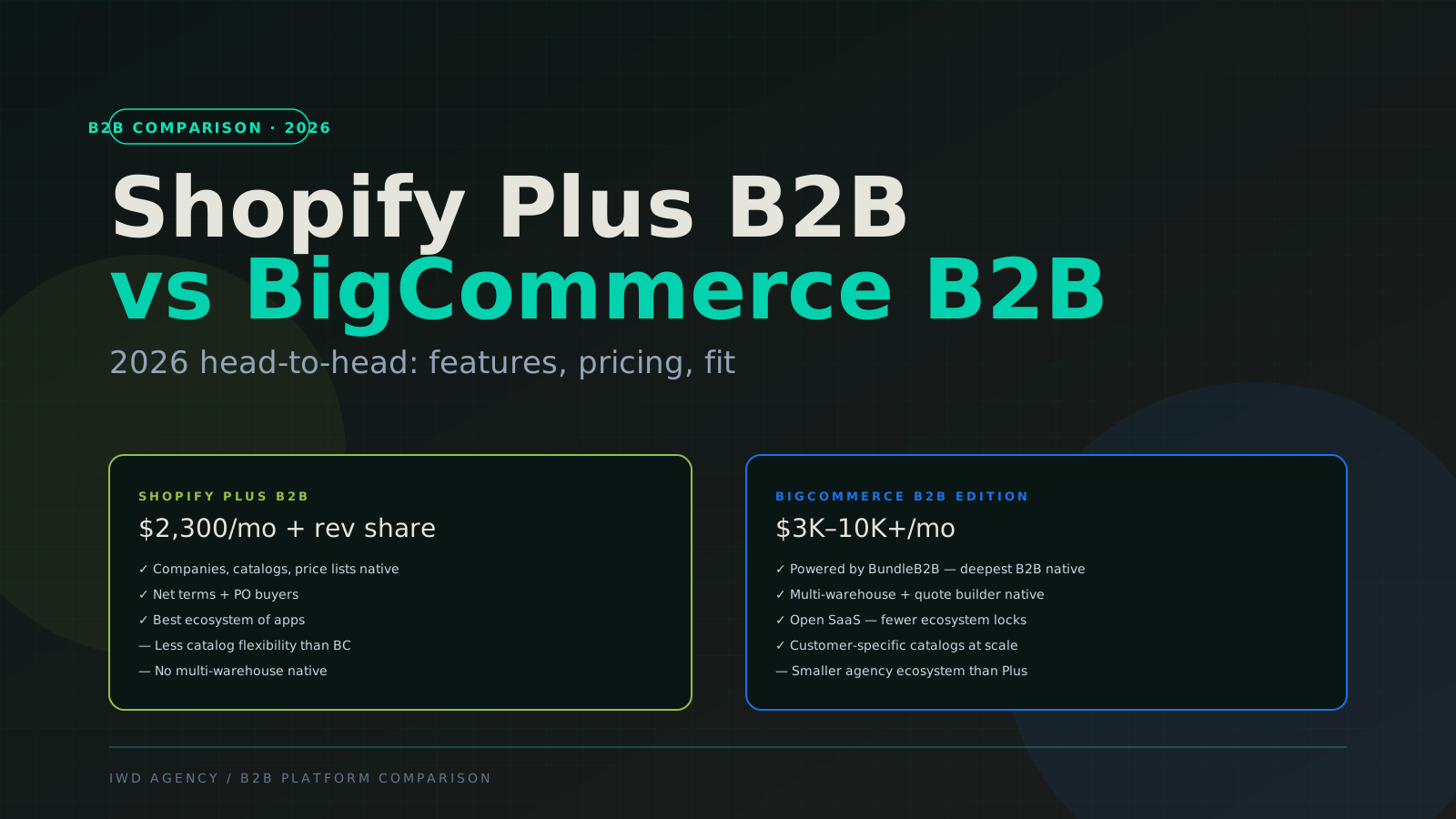
The Shopify Plus B2B vs BigCommerce B2B Edition decision is one of the most consequential platform choices a manufacturer, distributor, or wholesaler will make in the next decade. Both platforms ship native B2B features that previously required Magento B2B Edition or significant custom development. Both have matured significantly in the last 24 months. And the right pick can vary substantially based on whether you need unified B2B and DTC under one tenant, what your ERP integration story looks like, and how your sales team handles quotes today.
This guide is the side-by-side comparison we walk through during scoping calls with new B2B clients. It's based on 100+ B2B builds delivered across both platforms.

The 30-Second Verdict
If you're scanning, here's the short version:
- Shopify Plus B2B wins for brands that need unified B2B and DTC under one storefront, want faster time-to-launch, and prefer the deeper app ecosystem.
- BigCommerce B2B Edition wins for brands with standard B2B workflows (quote-to-cart, requisition lists, net 30) at mid-market budget, brands that need stronger native quote handling, and brands hitting API rate limits on Shopify Plus.
- Both beat building B2B on Shopify Advanced, BigCommerce Pro, or pure custom development from scratch.
Below is the full breakdown.
What Each Platform Ships Natively
The native B2B feature set is the single biggest comparison point. Both platforms cover the basics; the differences are in workflow specifics.
| B2B Capability | Shopify Plus B2B | BigCommerce B2B Edition |
|---|---|---|
| Company accounts | Native | Native |
| Buyer hierarchy + role-based permissions | Native | Native (deeper role granularity) |
| Customer-scoped catalogs | Native (catalog rules per company) | Native (price lists per customer group) |
| Custom pricing | Native (volume pricing + custom price lists) | Native (unlimited price lists) |
| Quote-to-order workflow | Draft orders + apps (Helium, Sparklayer) | Native quote-to-cart with approval routing |
| Net 30 payment terms | Native + gateway (Shop Cash, manual invoicing) | Native + gateway integration |
| Sales rep impersonation | Native (Shopify POS Sales Rep) | Native (admin "Login as Customer") |
| Requisition lists / shopping lists | Apps required | Native |
| Unified B2B + DTC under one tenant | Native (single tenant, customer-type routing) | Multi-Storefront required (separate B2B storefront) |
| Multi-warehouse + multi-currency | Shopify Markets + Locations | Multi-Storefront + Channels API |
Quote-to-cart and requisition lists are the workflow areas where BigCommerce ships more out of the box. Unified B2B + DTC and the broader app ecosystem are where Shopify Plus pulls ahead.
Where Shopify Plus B2B Wins
Unified B2B and DTC under one tenant
Plus B2B is the only platform in the comparison where you can run B2B and DTC under a single storefront with customer-type-aware routing. Same admin, same product catalog, same fulfilment workflow, with different pricing and checkout experiences per buyer type.
For brands transitioning from wholesale-only to mixed channel (or vice versa), this matters a lot. You don't run two storefronts. You don't sync inventory between two tenants. The Shopify Plus B2B vs BigCommerce architectural decision tilts heavily here for brands with meaningful DTC volume.
Hydrogen and the headless story
If you're going headless, Hydrogen plus Oxygen is a more polished story than BigCommerce Catalyst. Hydrogen ships opinionated React Server Components, edge caching, and tight Plus admin integration. Catalyst is solid but newer and less mature.
Time-to-launch
Standard Shopify Plus B2B builds land in 8 to 14 weeks. BigCommerce B2B Edition runs 8 to 16 weeks for comparable scope. The 2 to 4 week delta isn't huge, but it's consistent across the engagements we've shipped.
Shopify Functions for custom checkout logic
Functions (delivery customization, payment customization, discount logic, cart transformation) run server-side in Shopify's checkout. They're powerful and Plus-only. BigCommerce has comparable extensibility via Catalyst hooks but Functions is the more mature path for custom B2B checkout behavior.
App ecosystem depth
The Shopify App Store has a meaningfully deeper B2B-adjacent ecosystem (ReCharge, Sparklayer for quotes, Helium Customer Fields, Klaviyo with native B2B segmentation). BigCommerce's app ecosystem is solid but smaller.
Where BigCommerce B2B Edition Wins

Native quote-to-cart workflow
BigCommerce ships a full native quote-to-cart workflow with approval routing, expiration dates, and buyer-facing quote management. On Plus, you assemble this via draft orders plus an app (Sparklayer or Helium). For B2B-first brands where quotes drive 50%+ of orders, the native workflow is a meaningful win.
Native requisition and shopping lists
Native on BigCommerce. App-required on Shopify Plus B2B. Less of a differentiator for product-catalog-heavy brands but useful for parts distributors and MRO suppliers.
Higher API rate limits
BigCommerce Storefront API and Bulk API limits are notably higher than Shopify Plus equivalents. For high-frequency catalog sync from ERPs, multi-channel inventory updates, or large customer-group price list management, BC's headroom matters.
Lower platform fee at certain GMV brackets
BigCommerce's Enterprise pricing competes well with Shopify Plus at the 5M to 25M GMV bracket where Plus B2B's revenue-share tier kicks in. Math varies by deal but worth modelling at your specific volume.
Multi-Storefront for international
BigCommerce Multi-Storefront is a mature native multi-region pattern with per-storefront catalogs, currencies, and languages. Shopify Markets has caught up but the BC pattern is more developer-friendly for complex regional B2B scenarios.
Time-to-Launch and Cost Comparison
The build timeline and cost varies by complexity. Here's the typical range across our recent engagements.
| Build Phase | Shopify Plus B2B | BigCommerce B2B Edition |
|---|---|---|
| Discovery + audit | 1-2 weeks, 5K-10K | 1-2 weeks, 5K-10K |
| Theme + B2B configuration | 4-7 weeks, 35K-75K | 5-8 weeks, 40K-85K |
| ERP integration (NetSuite, SAP, etc) | 3-5 weeks, 25K-60K | 3-5 weeks, 25K-60K |
| QA, UAT, cutover | 1-2 weeks, 8K-15K | 1-2 weeks, 8K-15K |
| Total typical range | 8-14 weeks, 90K-250K | 8-16 weeks, 100K-275K |
| Annual platform fee (5M-25M GMV bracket) | Plus base + GMV revenue share past threshold | BC B2B Edition base (often lower at this bracket) |
The Five Questions That Should Drive Your Decision
Five-question decision framework
1. Do you sell DTC AND B2B from the same brand, or B2B-only?
DTC + B2B: Shopify Plus B2B wins. Unified tenant is a real cost and operational saver.
B2B-only: Either platform works. Move to question 2.
2. What percentage of orders come through quotes vs direct purchase?
50%+ quotes: BigCommerce B2B Edition's native quote-to-cart workflow saves you from layering Sparklayer or Helium on top of Plus.
Under 25% quotes: Plus B2B's lighter quote story is fine and the unified tenant advantage matters more.
3. Are you running headless or planning to in the next 18 months?
Hydrogen-leaning: Plus B2B. Hydrogen plus Oxygen is the more mature headless story for B2B + DTC unified front-ends.
Catalyst-leaning or custom Next.js: Either works. Both have solid GraphQL Storefront APIs.
4. What's your ERP, and how chatty does the integration need to be?
NetSuite, SAP, Dynamics 365, Acumatica with high-frequency catalog or inventory sync: BigCommerce's higher API rate limits matter. Plus is workable but you'll hit limits sooner.
Low-frequency or smaller ERPs: Either platform works at standard sync cadence.
5. Do you need very deep customer-group hierarchy (5+ levels, complex permission rules)?
Yes: BigCommerce B2B Edition's role granularity is stronger. Adobe Commerce B2B Edition is also worth considering at this complexity.
2-3 levels of buyer hierarchy: Either platform covers it cleanly.
When to Consider Adobe Commerce B2B Instead
Neither Shopify Plus B2B nor BigCommerce B2B Edition is always the right answer. Adobe Commerce B2B Edition is a stronger fit if you check most of these boxes:
- 50M+ GMV with deep customisation requirements
- Multi-warehouse logistics with complex fulfilment routing per customer group
- Industry-specific compliance (medical, aerospace, government contracting)
- Existing Adobe Marketing or Analytics Cloud stack you want to integrate tightly
- Highly custom quote logic that goes beyond approval routing (multi-tier negotiated terms, CPQ-integrated)
- Team headcount and skills already aligned to PHP/Magento development
Adobe Commerce B2B Edition costs more (license + build) but ships native shared catalogs, native quote-to-order with multi-tier approval, native requisition lists, and the deepest customer-group customisation in the market.
Frequently Asked Questions
Can we run B2B and DTC on the same Shopify Plus store?
Yes. Plus B2B's native architecture supports unified B2B + DTC under one tenant with different customer experiences per buyer type. Catalog scoping, pricing, payment terms, and checkout flow differ by buyer; admin and inventory stay unified.
Does BigCommerce B2B Edition support unified B2B + DTC?
Yes, but the recommended pattern is Multi-Storefront with separate B2B and DTC storefronts under one tenant. Some brands run B2B and DTC in a single BC storefront with price lists, but the Multi-Storefront approach gives you cleaner buyer experience separation.
What about migrating from Magento B2B to Shopify Plus B2B or BigCommerce B2B Edition?
Migrations from Magento B2B to either platform are common. Customer groups, price lists, and catalogs migrate. Custom Magento B2B modules map to native features where possible. Gaps get filled with Shopify Functions, BigCommerce custom widgets, or third-party B2B apps. Timeline: 12 to 20 weeks for Magento B2B to Plus B2B or BC B2B Edition.
Can both platforms integrate with NetSuite ERP?
Yes. Both have native API support plus connector ecosystems. Our team ships both Shopify Plus B2B + NetSuite and BigCommerce B2B Edition + NetSuite integrations regularly. Our dedicated NetSuite Connector cuts NetSuite integration timeline by 4 to 6 weeks on either platform.
How long does a B2B build take on each platform?
Standard B2B Edition builds: 8 to 14 weeks on Plus, 8 to 16 weeks on BC. Complex multi-warehouse or multi-subsidiary B2B builds extend to 16 to 20 weeks on either. Migrations from Magento B2B run 12 to 20 weeks.
What if we change our minds later?
Replatforms from Plus B2B to BC B2B Edition (or vice versa) are doable but they're real projects (8 to 12 weeks). Pick the platform that fits your current and 24-month outlook well. Don't overthink the 5-year-out scenarios; the platforms keep maturing and feature parity keeps closing.
Related Reading and Service Pages
- B2B eCommerce Agency: cross-platform B2B positioning
- Shopify Plus B2B services
- BigCommerce B2B development
- Adobe Commerce B2B Edition
- Best B2B eCommerce Platforms in 2026
- What is BigCommerce?
- What is Shopify?
Our team handles both platforms
We're a Shopify Plus Partner and a BigCommerce Partner. Our discovery phase produces a written recommendation with rationale, not a platform pitch. If neither platform fits, we'll tell you and point you at Adobe Commerce B2B instead.