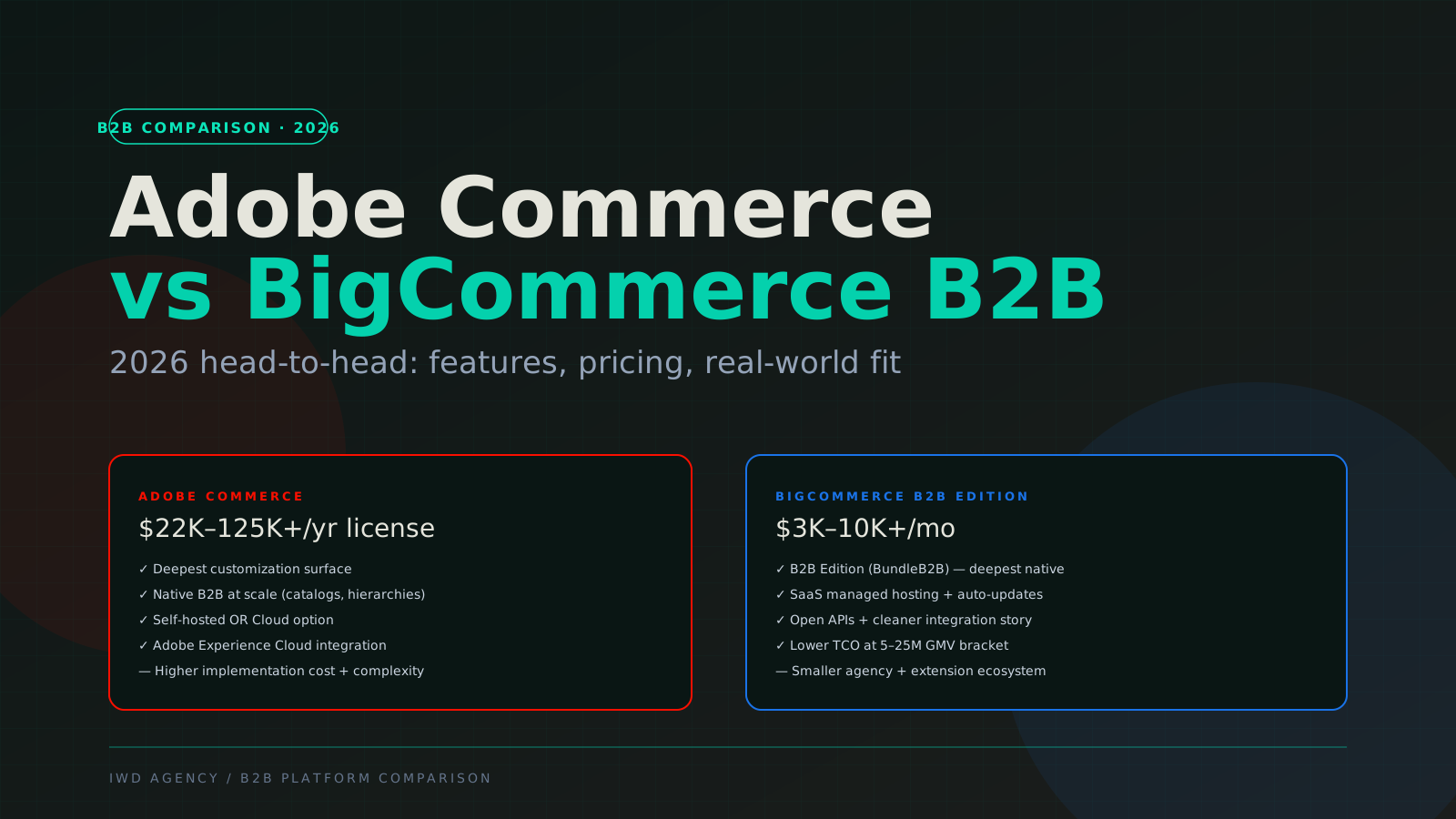
Last updated: May 25, 2026 · 18 min read · By Joe McFerrin, CEO of IWD Agency
Adobe Commerce B2B vs BigCommerce B2B Edition is the comparison most B2B-focused brands face when they've already ruled out Shopify Plus B2B for their requirements. Both platforms ship native B2B features that Shopify Plus can't match natively, multi-tier customer hierarchies, customer-specific catalogs, complex quote workflows, and deep ERP integration. The decision between Adobe and BigCommerce comes down to operational complexity, hosting model preference, and total cost of ownership. We write it as an Adobe Commerce agency that has shipped B2B builds on both platforms.
This guide is the comprehensive comparison our team uses on every scoping call where Adobe Commerce and BigCommerce B2B Edition are both finalists. It covers pricing structures, B2B feature depth, hosting models, ERP integration economics, multi-region capability, and the decision framework.
If you're earlier in the platform evaluation and haven't ruled out Shopify Plus, pair this with our Shopify Plus B2B vs BigCommerce B2B Edition and Shopify Plus vs Adobe Commerce 2026 comparisons.
The 30-Second Verdict
| Your situation | Pick |
|---|---|
| 5-25M GMV, standard B2B (catalogs + quotes + net terms) | BigCommerce B2B Edition — better TCO, simpler ops |
| 25M+ GMV, complex B2B with multi-tier hierarchies | Adobe Commerce — handles complexity native at scale |
| Existing Magento codebase + sunk investment | Adobe Commerce — migration cost rarely justifies switch |
| Deep ERP integration with NetSuite/SAP/MS Dynamics | Either — Adobe wins at extreme depth; BC wins at standard |
| On-prem or self-hosted required | Adobe Commerce — BigCommerce is SaaS-only |
| Adobe Experience Cloud integration needed | Adobe Commerce — native AEM + Marketo + Target |
| Multi-region (5+ countries) at enterprise scale | Adobe Commerce — multi-storefront more mature than BC |
| Multi-storefront (multiple brands on one backend) | BigCommerce — multi-storefront architecture is cleaner |
| Faster time-to-market priority (< 5 months) | BigCommerce — SaaS economics + smaller build scope |
| Lower implementation cost priority | BigCommerce — typically 30-50% cheaper to build |
Pricing Side-by-Side
| Cost line | Adobe Commerce | BigCommerce B2B Edition |
|---|---|---|
| Platform license (entry) | $22K/yr (B2B Starter) | $3K/mo (~$36K/yr) Enterprise + B2B add-on |
| Mid-tier (10M GMV) | $40K/yr (B2B Mid) | $5-7K/mo (~$60-84K/yr) |
| Enterprise (50M+ GMV) | $125K+/yr (Pro Cloud) | $10-15K/mo (~$120-180K/yr) |
| Hosting | Self-hosted $15-50K/yr OR Cloud bundled | Bundled SaaS |
| Native B2B add-on cost | Included (Starter+) | $1-3K/mo additional |
| Implementation (B2B build) | $125-400K | $80-280K |
| Headless build | $150-450K (PWA Studio or Next.js) | $100-300K (Catalyst) |
| App ecosystem | $3-7.5K/mo | $1.5-4K/mo |
| Dev retainer | $12-35K/mo | $8-25K/mo |
At 10M GMV total annual TCO: Adobe Commerce ~$350K vs BigCommerce B2B Edition ~$280K. BigCommerce wins by ~20% on direct cost. Above 25M GMV with complex B2B, the gap narrows; Adobe Commerce's pricing advantages compound at higher complexity.
B2B Feature Depth — The Critical Comparison
This is where most B2B brands make the actual decision. Both platforms ship deep native B2B; the differences matter at edge cases.
| B2B Feature | Adobe Commerce native B2B | BigCommerce B2B Edition |
|---|---|---|
| Company/buyer accounts | ✓ Native | ✓ Native (BundleB2B) |
| Customer-specific catalogs | ✓ Native, deepest | ✓ Native (very strong) |
| Multi-tier customer pricing | ✓ Unlimited tiers | ✓ Unlimited tiers |
| Multi-level company hierarchies (parent/child) | ✓ Native | ✓ Native (BundleB2B is industry-leading) |
| Approval workflows (multi-step) | ✓ Native | ✓ Native |
| Quote-to-order workflow | ✓ Native | ✓ Native (Quote Builder) |
| Requisition lists | ✓ Native | ✓ Native (Quick Add) |
| Net 30/60/PO terms | ✓ Native | ✓ Native |
| Sales rep representation | Native + Sales Rep tools | ✓ Native ("Logged in as customer") |
| Tax-exempt purchase flows | ✓ Native | ✓ Native |
| Multi-warehouse inventory | ✓ Native + custom | ✓ Native (multi-storefront approach) |
| ERP-native sync | ✓ Strong API depth | ✓ Strong (open APIs) |
| Customer dashboard | ✓ Native (basic) | ✓ Native (richer) |
| Custom buying tools | Custom dev required | App ecosystem stronger |
Honest assessment: BigCommerce B2B Edition (powered by their 2022 BundleB2B acquisition) has the most polished native B2B feature set in 2026. Adobe Commerce native B2B is deeper for customization but BigCommerce ships more polished out-of-the-box.
For straightforward enterprise B2B implementations, BigCommerce gets you to production faster. For deeply customized B2B with custom workflows, Adobe Commerce's deeper customization surface is the better fit.
Hosting Models
| Adobe Commerce | BigCommerce B2B Edition | |
|---|---|---|
| Default hosting | Self-hosted OR Cloud | SaaS managed (BC-hosted) |
| Hosting included in license? | Only Pro Cloud tier | Yes — always |
| Auto-updates | Apply yourself (or agency) | BigCommerce pushes |
| Custom infrastructure | Yes (self-hosted) | No |
| Multi-region | Manual configuration | Multi-storefront natively |
| Uptime SLA | 99.9% (Cloud), DIY otherwise | 99.99% |
| DevOps overhead | High (self-hosted) / Low (Cloud) | Zero |
| PCI compliance | Customer responsibility | BC manages |
The operational difference: Adobe Commerce self-hosted requires real DevOps investment. BigCommerce removes that entirely. For brands without deep Magento/PHP infrastructure expertise, BigCommerce's SaaS economics are meaningful.
Multi-Storefront vs Multi-Region
Both platforms handle multi-store scenarios but differently:
Adobe Commerce — Multi-Region via Single Backend
Adobe Commerce's multi-store architecture treats regional storefronts as views of one backend (single product catalog, single customer base, regional overlays). Strong for true multi-region brands selling the same products across countries with regional pricing and tax.
BigCommerce — Multi-Storefront via Single Account
BigCommerce's multi-storefront architecture treats each storefront as more independent — different catalogs, different customer bases, shared admin. Stronger for multi-brand scenarios (parent company with 3-5 distinct brand storefronts).
| Use case | Adobe wins | BC wins |
|---|---|---|
| Same brand across 5+ regions | ✓ | |
| Parent company with 3-5 distinct brands | ✓ | |
| Hybrid wholesale + retail brand portfolio | ✓ | |
| Multi-language + multi-currency single brand | ✓ | |
| Acquisition strategy adding distinct brands | ✓ |
ERP Integration Comparison
Both platforms have mature ERP integration patterns. See our NetSuite Integration Guide 2026 for the architectural framework that applies to both.
| ERP integration | Adobe Commerce | BigCommerce |
|---|---|---|
| Pre-built NetSuite connector | ✓ Celigo + custom + IWD's in-house connector | ✓ Celigo + Boomi |
| Pre-built SAP integration | ✓ Strong | ✓ Strong |
| Pre-built MS Dynamics | ✓ Strong | ✓ Strong |
| Real-time bidirectional sync | ✓ Native depth | ✓ Native depth |
| Custom field mapping flexibility | High | High |
| Open API quality | Strong (REST + GraphQL) | Excellent (open APIs are a key positioning) |
| Typical Tier 1 integration cost | $8-25K | $8-25K |
| Typical Tier 2 middleware cost | $35-90K | $30-80K |
| Typical Tier 3 custom cost | $60-200K | $50-180K |
BigCommerce wins slightly on API ergonomics. Their open SaaS positioning means clean APIs are a strategic priority. Adobe Commerce APIs are equally functional but the surface is more complex (REST + GraphQL + SOAP variants).
Headless / Composable
| Headless | Adobe Commerce | BigCommerce |
|---|---|---|
| Native headless framework | PWA Studio | Catalyst (Next.js-based) |
| Custom framework support | Next.js, Astro, custom | Next.js, custom |
| Edge rendering | Vercel, Netlify, custom | Catalyst-optimized + custom |
| Headless build cost | $150-450K | $100-300K |
| Best-in-class examples | Helly Hansen, Bremont | Burrow, Skullcandy |
| Community ecosystem | Smaller | Growing fast |
See our Headless Commerce 2026 guide for deeper framework analysis.
Decision Framework
Pick by your specific situation
5-25M GMV, standard B2B workflows (catalogs + quotes + net terms)
BigCommerce B2B Edition. Lower TCO, faster time-to-market, polished out-of-the-box B2B. Adobe Commerce at this scale is technically capable but operationally heavier than necessary.
25M+ GMV with complex customization (custom quote workflows, custom approval chains, custom buying tools)
Adobe Commerce. Deeper customization surface, on-prem option if needed, strongest native B2B at extreme complexity. BigCommerce can handle most of this but Adobe Commerce wins at the extremes.
Existing Magento codebase with significant sunk investment
Adobe Commerce. Migrating Magento → Adobe Commerce 2 is 4-9 months at $100-300K. Migrating Magento → BigCommerce is 6-12 months at $200-500K. The math rarely justifies leaving the Magento ecosystem unless DTC operational simplicity is decisive.
On-prem or sovereign cloud deployment required
Adobe Commerce. BigCommerce is SaaS-only — no on-prem option. Adobe Commerce can deploy on-prem, in private cloud, or in sovereign-cloud regions.
Deep Adobe Experience Cloud integration (Marketo, AEM, Target, Analytics)
Adobe Commerce. Native Adobe ecosystem integration. Brands invested in Adobe's broader stack should pick Adobe Commerce.
Multi-brand portfolio (3-5 distinct brand storefronts)
BigCommerce. Multi-storefront architecture is cleaner for distinct brands than Adobe Commerce's multi-region approach.
Single brand across 5+ regions with regional pricing/tax
Adobe Commerce. Multi-region native architecture is mature; BigCommerce can do this but requires more configuration.
Don't have a Magento-capable dev team and don't want to build one
BigCommerce. SaaS economics + smaller talent gap = faster operational maturity. Adobe Commerce self-hosted requires DevOps expertise that BigCommerce doesn't.
Budget-constrained but need real B2B (sub-15M GMV)
BigCommerce B2B Edition. Lower implementation cost + lower platform fee + lower app stack at the same B2B feature depth.
Building entirely custom workflows + integration tooling
Adobe Commerce. The deeper customization surface justifies the complexity at extreme custom build scenarios.
Want a second opinion on this decision?
Our Adobe Commerce experts scope Adobe Commerce and BigCommerce B2B builds every week and will tell you honestly which one fits your catalog, your ERP, and your buyers, including when the answer is the cheaper platform. Senior, certified, and available to engage or embed with your team.
Total Cost of Ownership at 3 GMV Brackets
Frequently Asked Questions
Common questions about Adobe Commerce vs BigCommerce B2B
Which platform has better native B2B in 2026?
BigCommerce B2B Edition has the most polished out-of-the-box B2B feature set. Powered by their 2022 BundleB2B acquisition. Adobe Commerce native B2B is deeper for customization. For straightforward enterprise B2B, BigCommerce ships faster. For deeply customized B2B, Adobe Commerce's customization surface wins.
Which is cheaper to run?
BigCommerce wins on direct TCO by ~15-25% across most GMV brackets. The advantage is biggest at 5-15M GMV where Adobe Commerce's customization surface isn't fully utilized. Above 25M GMV with complex requirements, the gap narrows or flips based on customization needs.
Can BigCommerce handle enterprise B2B at 50M+ GMV?
Yes — at this point. BigCommerce B2B Edition has been production-validated at $100M+ GMV implementations since 2023. The historical "BC isn't enterprise" reputation pre-dates the BundleB2B acquisition. Modern BC B2B Edition is genuinely enterprise-grade for most use cases.
When does Adobe Commerce win clearly over BigCommerce?
Five specific scenarios: (1) Existing Magento codebase with significant sunk investment, (2) on-prem or sovereign cloud deployment required, (3) deep Adobe Experience Cloud integration (Marketo, AEM, Target), (4) extreme customization requirements that exceed BC's app/extension surface, (5) genuine multi-region enterprise (5+ countries with regional overlays).
Which has better ERP integration?
Roughly equivalent. Both have mature NetSuite, SAP, MS Dynamics integration patterns via Celigo, Boomi, and custom development. BigCommerce wins slightly on API ergonomics (open APIs are a strategic positioning). Adobe Commerce wins on deepest customization. For 90% of ERP integration scopes, either works.
What about Shopify Plus B2B in this comparison?
Shopify Plus B2B is a different conversation. It's the entry-level enterprise B2B option — cheaper and faster than either Adobe or BigCommerce but with B2B feature ceilings. Brands at 5-25M GMV with simple wholesale often pick Shopify Plus. See our Shopify Plus B2B vs BigCommerce B2B for that comparison.
How long does each platform take to launch a B2B store?
BigCommerce B2B Edition build: 14-22 weeks typical. Adobe Commerce B2B build: 22-36 weeks typical. Either platform with deep ERP integration: add 6-10 weeks. Adobe Commerce takes longer because of platform complexity and the deeper customization most clients pursue.
Which has better multi-storefront capability?
Depends on use case. BigCommerce multi-storefront is cleaner for distinct brand portfolios (parent company with 3-5 separate brand sites). Adobe Commerce multi-region is stronger for one brand across 5+ countries with regional overlays. Pick by your specific multi-store pattern.
Can I migrate from Adobe Commerce to BigCommerce (or vice versa)?
Yes but expensive. Adobe Commerce → BigCommerce migration: 6-12 months, $200-500K. BigCommerce → Adobe Commerce: 6-12 months, $250-600K. Justified only when the cost of staying on the wrong platform exceeds the migration cost over a 3-year horizon — rare scenario.
Which platform's pricing is more predictable?
BigCommerce pricing is more transparent. Published Enterprise tiers ($3-15K/mo) with B2B Edition add-ons. Adobe Commerce pricing is opaque — you negotiate via quote based on declared GMV. For budget predictability, BC is easier. For negotiation upside, Adobe is more flexible (15-30% movement common).
Related Reading
Adobe Commerce Pricing 2026 · Shopify Plus vs Adobe Commerce 2026 · Shopify Plus B2B vs BigCommerce B2B Edition · Best Adobe Commerce Agencies in 2026 · Best BigCommerce Agencies in 2026 · NetSuite Integration Guide 2026
If you're evaluating Adobe Commerce vs BigCommerce B2B Edition for your build, book a 30-minute platform assessment. Our team builds on both platforms — we'll walk through fit honestly including whether Shopify Plus B2B might also be worth considering.
Work with IWD
IWD builds B2B commerce on both platforms. Explore our B2B ecommerce agency, Magento B2B agency, Adobe Commerce experts, and BigCommerce B2B.