

 Partner

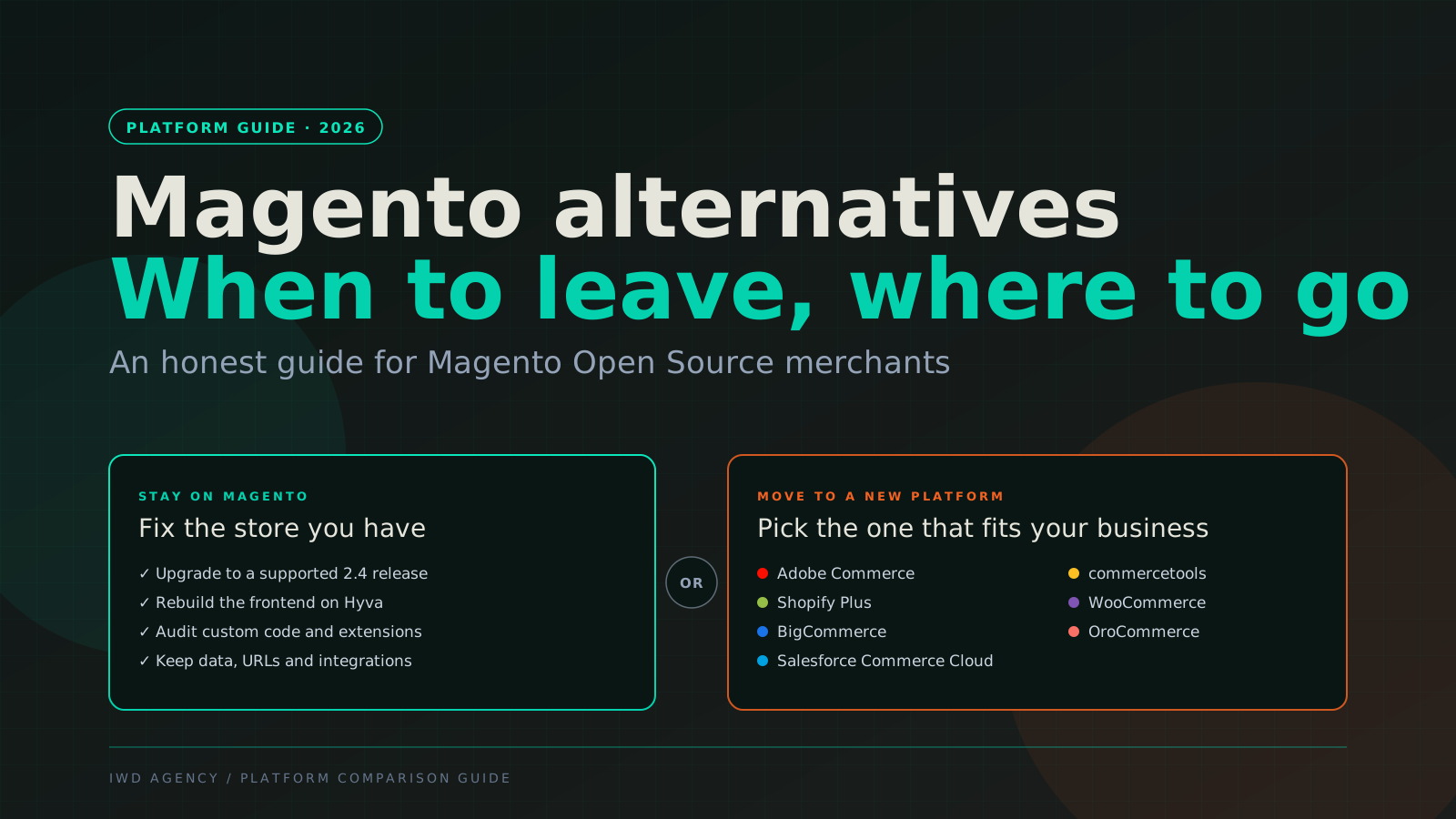
Most merchants who search for Magento alternatives are not unhappy with what Magento can do. They are tired of what it takes to keep it running: an upgrade that keeps slipping, an extension that breaks checkout after a patch, a storefront that scores poorly on mobile, a developer who moved on. Some of those problems are good reasons to replace Magento. Others would follow you to the next platform, or cost far less to fix where you are.
This guide is for merchants on Magento Open Source deciding whether to stay or go. It starts with the case for staying, because it is often the cheaper answer, then compares the alternatives to Magento that merchants choose most often. We build on Magento, Adobe Commerce, Shopify Plus and BigCommerce, and we run version upgrades as well as full Magento migration services, so we work on both sides of this decision.
If your store can get onto a supported Magento 2.4 release and your complaints are speed, upkeep or code quality, fix Magento before you leave it. An upgrade, a Hyva frontend and a code audit cost less than a replatform and keep everything that already works.
If you no longer want to own hosting, patching and upgrades, and your needs are fairly standard, Shopify Plus or BigCommerce is often the better answer. If you need more B2B depth, look at Adobe Commerce first, because it runs on the same code.
Why merchants start looking for Magento alternatives
Most of the reasons come back to ownership. Magento Open Source is free under the OSL 3.0 license and gives you the full code. That control is why many businesses chose it, and it means everything Adobe does not do for you is yours to do:
- Upgrades run on a clock. Adobe supports each 2.4.x release line for three years. Standard support for 2.4.6 ended on August 11, 2026, and the extended windows in Adobe's lifecycle policy are written for Adobe Commerce customers, so an Open Source store on 2.4.6 should be treated as unsupported.
- PHP runs on its own clock. PHP 8.2 stops getting security fixes on December 31, 2026, and Magento 2.4.6 cannot run anything newer.
- Security is your job. Adobe publishes the patches. Applying and testing them, and keeping hosting, search and every extension current, falls to your team or partner.
- Extensions pile up. Company accounts, shared catalogs and quotes ship with Adobe Commerce but need extensions or custom work on Open Source, and every extension has to survive the next upgrade.
- The default frontend is slow. Many older stores still run Luma, Magento's original theme, and struggle with Core Web Vitals on mobile.
- Developers are hard to keep. When the one person who understood a heavily customized codebase leaves, every change gets slower and riskier.
Only one or two of those are about what Magento can do. The rest are about maintenance, and a new platform fixes maintenance only if it takes that work off your hands.
You may not need to leave Magento
Before you price a replatform, price the work of fixing the store you have. Three pieces of work solve most of the problems above, and none of them moves your catalog, customers, order history or URLs.
Get onto a supported Magento 2.4 release
The current version is Magento 2.4.9, released on May 12, 2026 for both Open Source and Adobe Commerce. Standard support runs until May 31, 2027 for 2.4.7, May 31, 2028 for 2.4.8 and May 31, 2029 for 2.4.9, and Adobe still ships a full patch release every May. Every release line and deadline is in our guide to Magento 2.4 release and end-of-support dates.
Treat the upgrade as a project. The version change is the small part. The work sits in PHP, search and database versions, extensions and custom modules, and in proving that checkout and integrations still work. Our Magento upgrade services run that work on a staging copy of your store and touch production once, with a rollback ready. Our guide to the cost of upgrading Magento shows where the budget goes.
Upgrades get easier when they are routine. Purdue Extension, which runs Magento Open Source, gets a planned platform upgrade every year, with each extension patched for the current PHP release, so no single upgrade becomes a rescue project.
Replace the frontend with Hyva before you replace the platform
Hyva, from Hyvä Themes, is a replacement frontend for Magento. It swaps the heavy JavaScript stack behind Luma for a lighter one built on Tailwind CSS and Alpine.js, and it runs on the backend you already have, on Open Source and Adobe Commerce. Catalog, checkout logic, integrations and admin stay where they are. For a store whose main complaint is speed, that is the difference between a frontend project and a replatform.
Since November 10, 2025, the Hyva Theme itself has been free and open source under the OSL 3.0 and AFL 3.0 licenses; Hyva Checkout and Hyva Commerce remain commercial. The real cost is the work: your theme is rebuilt on Hyva, and every storefront extension needs a Hyva-compatible version or a small compatibility module. Our Hyva theme development team can plan the rebuild together with an upgrade, so both land in one release.
Audit the code before you judge the platform
When a Magento store feels fragile, the cause is usually specific: extensions that override core behavior, custom modules written against an old version, or integrations patched in a hurry. A Magento code audit finds them and shows which extensions you can remove and how much custom code is worth keeping. Years of workarounds that need rebuilding anyway are a strong signal to leave. A sound store with a few bad extensions has just saved you a replatform.
Staying on Magento is usually right when these are true
- Your store runs, or can upgrade to, a supported 2.4 release without rewriting most of its custom code.
- Your main complaints are speed, upgrade pain or extension conflicts.
- You rely on code-level control: custom checkout steps, real-time ERP lookups, unusual pricing logic or rules about where data lives.
- You have, or can keep, experienced Magento developers in house or through a partner.
- Your integrations work and would be expensive to rebuild.
When it is time to replace Magento
Staying is not always right. These signals point to a different platform:
- You no longer want to own the platform. If nobody wants to be responsible for hosting, patching and upgrades, SaaS is designed for exactly that.
- Your needs have become standard. If your catalog, pricing and checkout now fit what a hosted platform does out of the box, your custom code is cost without benefit.
- You are far behind. Regular support for 2.4.0 to 2.4.3 ended on November 28, 2022. A store on those versions, or on Magento 1, faces a migration-sized project either way, so choose the platform you would pick today.
- The audit says rebuild. If the frontend and most custom modules need rewriting anyway, the extra cost of a replatform is smaller than it looks.
- You cannot staff it. If you have tried and failed to keep Magento developers or a reliable partner, an easier platform is a legitimate business decision.
- You need B2B depth that Open Source lacks. That often points to Adobe Commerce rather than out of the Magento family.
How the main Magento competitors compare
Here are the main Magento competitors on the points that decide most moves. Pricing changes, so check each vendor's current terms before you sign.
| Platform | Model | Licensing cost basis | B2B depth | Best fit |
|---|---|---|---|---|
| Magento Open Source (where you are) | Open source, self-hosted | No license fee (OSL 3.0); you pay for hosting, development and maintenance | Customer group and tier pricing; company accounts, shared catalogs and quotes need extensions | Full control on a smaller budget, with strong developers |
| Adobe Commerce | Licensed edition of Magento, self-hosted or on Adobe's cloud, plus a SaaS edition | Annual license quoted by Adobe based on your revenue | Deep and native: company accounts, shared catalogs, negotiable quotes, purchase order approvals | Complex B2B and heavy ERP traffic, keeping your Magento code |
| Shopify Plus | SaaS | From $2,300 a month on a three-year term, plus a variable fee based on sales for larger businesses | Company accounts, net terms, volume pricing, unlimited catalogs; quotes and approvals usually need an app | DTC and simpler B2B, a fast launch, a small team |
| BigCommerce | SaaS, marketed as Open SaaS | Performance plan from $1,499 a month billed annually, with B2B Edition quoted on top | Company accounts, buyer portal, quotes, purchase orders, price lists, buyer approvals | Quote-heavy B2B without running servers |
| Salesforce Commerce Cloud | Enterprise SaaS | Not published; quoted by Salesforce | Separate B2B Commerce product on the Salesforce Platform | Large brands already invested in Salesforce |
| commercetools | Composable, API-first SaaS | Not published; quoted on an order-based model | B2B building blocks as APIs; you build the buyer experience | Enterprise teams building a custom headless stack |
| WooCommerce | Open source WordPress plugin, self-hosted | Free plugin; you pay for hosting, extensions and development | Through third-party plugins | Small, content-led stores already on WordPress |
| OroCommerce | Open source, built for B2B | Community Edition free; Enterprise Edition licensed and quoted | Built in: company accounts, quotes, buying workflows, complex price lists | B2B manufacturers and distributors who want open source |
What each of the alternatives to Magento does well
Adobe Commerce keeps you in the Magento family
Adobe Commerce is the licensed edition of Magento. It shares the codebase and ships on the same version numbers on the same days, and your extensions and custom modules are built for the same core. Moving from Open Source is an edition change rather than a replatform, so your catalog, customers, orders and URLs stay put.
The license adds depth: a native B2B suite with company accounts and roles, shared catalogs with company-specific pricing, negotiable quotes, requisition lists and purchase orders with approval rules. It also adds Adobe support, cloud hosting options and extended support, which gives Adobe Commerce customers on 2.4.6 and 2.4.7 an extra year of patches at no cost.
Adobe also offers Adobe Commerce as a Cloud Service, a SaaS edition it hosts and upgrades, though moving onto it is a real project. Adobe does not publish a price list; our Adobe Commerce pricing guide explains the revenue-based quote.
Choose Adobe Commerce when your B2B rules are complex, your ERP pushes data all day, and you want to keep your code, integrations and developers. Our Adobe Commerce migration team handles the edition change, including a version upgrade if you need both.
Shopify Plus offers the simplest operating model
Shopify Plus is SaaS. Shopify hosts the store, keeps the platform secure and releases upgrades without a project on your side. For a Magento merchant whose real problem is maintenance, that is the biggest change: there is no upgrade to plan and no server to patch.
B2B has improved a lot. Plus includes company accounts, net payment terms, volume pricing, quick order and unlimited catalogs; quotes and multi-step approvals usually mean an app. The API is metered, with Plus getting ten times the per-second allowance of a standard store and bulk operations for large jobs. That is plenty for most stores and can be tight for an ERP that pushes price changes all day.
The trade-off is control. You cannot change the core, host it yourself or change checkout beyond what checkout extensibility allows. Pricing starts at $2,300 a month on a three-year term, larger businesses pay a variable fee based on sales, and Shopify adds a fee on orders paid through a processor other than Shopify Payments. Our Shopify Plus pricing breakdown covers the details.
Choose Shopify Plus when you sell mainly direct to consumers or your B2B is straightforward, your systems have good off-the-shelf connectors and you want a small team to run the store. Our Shopify Plus agency team builds on it, our Magento to Shopify migration service moves catalog, customers and orders with 301 redirects to protect rankings, and our Shopify migration services page explains how we plan any move onto Shopify.
BigCommerce puts more B2B features in the box
BigCommerce is also SaaS, marketed as Open SaaS: hosted, but built around open APIs for connecting your own systems. Its main draw for B2B merchants is B2B Edition, with company accounts, a buyer portal, quotes, purchase orders, invoices and price lists, plus buyer roles where a junior buyer builds a list and a senior buyer approves it. It runs B2B and B2C on one store without platform transaction fees.
B2B Edition requires the top plan, Performance, which BigCommerce lists from $1,499 a month billed annually, with B2B Edition quoted on top. One API limit, set by your plan, is shared by every app on the store, and some of the largest stores get no set rate limit. You can customize more than on Shopify, but you still do not own the core code.
Choose BigCommerce when quotes and buyer approvals run your business and you do not want to run servers. Our BigCommerce agency team builds and supports these stores, and our BigCommerce migration services cover the move from Magento.
Salesforce Commerce Cloud suits brands already on Salesforce
Salesforce Commerce Cloud is an enterprise SaaS platform used by large retail brands, usually alongside the wider Salesforce suite. Salesforce B2B Commerce runs on the Salesforce Platform next to the CRM, so account, order and service data live in one ecosystem. Salesforce does not publish prices; each edition is contact for pricing.
It is rarely the natural next step for a Magento Open Source store, because the contracts and implementation are sized for large enterprises. It makes sense when your company already runs Salesforce for sales, service or marketing, and if that is you, our Salesforce Commerce Cloud agency team can help you scope it.
commercetools is composable commerce for teams that build
commercetools is a composable, API-first SaaS platform for fully custom headless builds at enterprise scale. It provides the commerce engine as services, including B2B building blocks such as business units, buyer roles, approval rules and quotes, while the storefront, search and content are pieces your team chooses and integrates. Pricing is not published; commercetools describes an order-based model.
For merchants leaving Magento because maintenance is too heavy, commercetools adds work rather than removing it. It fits enterprises with several brands or channels and a strong engineering team. Our guide to composable commerce vs monolithic ecommerce and our headless commerce agency page go deeper.
WooCommerce is a sideways move for most Magento stores
WooCommerce is a free, open source ecommerce plugin for WordPress, popular with small, content-led stores. For a Magento merchant, it keeps the parts of open source that usually drive people away: you still choose hosting, apply updates and manage plugins, and B2B features come from third-party plugins. It can suit a small catalog with simple pricing. For a B2B store or a large catalog, it is a step sideways.
OroCommerce is open source built for B2B
OroCommerce is an open source platform designed for B2B from the start, with company accounts, quotes, buying workflows and complex price lists at its core. The Community Edition is free and open source; the Enterprise Edition is licensed, priced by quote and adds support for multiple organizations and websites. It is worth a look for manufacturers and distributors who want open source with B2B built in, but its developer and extension ecosystem is smaller than Magento's, so check partner availability first.
How to choose between staying and switching
Three questions settle most of these decisions:
- How much do you need to customize? If your checkout, pricing or integrations depend on changing how the platform works, you need code-level control: Magento, Adobe Commerce or a composable stack. If configuration and apps cover it, SaaS is on the table.
- How much data moves between your ERP and your store? Every price change, inventory update and order is an API call. Hosted platforms meter those calls; Magento and Adobe Commerce have no per-plan cap, because the ceiling is your servers.
- Who will maintain the store? Your team, a partner or the platform. This is usually the real reason merchants look for Magento alternatives, so answer it honestly.
If the answers are "a lot", "a steady stream" and "a partner", Magento or Adobe Commerce is usually still the right home. If they are "not much", "a trickle" and "the platform", look hardest at Shopify Plus or BigCommerce. For a wider view, our B2B ecommerce platforms comparison scores Shopify, Shopify Plus, BigCommerce, Magento and Adobe Commerce side by side, and our guide to SaaS vs open source ecommerce platforms covers the underlying choice. Our Magento agency team can give you a second opinion on whether your store is worth keeping.
What leaving Magento involves
If you decide to go, plan for more than a data export. A Magento replatform usually includes:
- Moving data: products, categories, customers and order history, cleaned on the way.
- Rebuilding integrations: ERP, PIM, tax, shipping and payments connect differently on every platform.
- Replacing extensions: each one becomes an app, a native feature or custom work, and some have no direct equivalent.
- Protecting search rankings: a 301 redirect for every old URL, with titles, descriptions and structured data carried over.
- Handling customer accounts: on many platforms passwords cannot move, so plan how customers reactivate their accounts.
- Testing before launch: checkout, B2B pricing, tax and integrations tested with real orders before you switch.
Our ecommerce replatforming team plans the destination and the move together, and our ecommerce migration checklist covers the first year after launch. Choose with the next three to five years in mind, and if the honest answer is that an upgrade solves the problem, take the upgrade.
Sources for the dates and prices in this guide
Vendors change their pricing and support terms, so confirm them before you budget.
- Adobe Commerce lifecycle policy, Adobe Experience League
- Shopify Plus pricing, Shopify
- BigCommerce pricing, BigCommerce
- Commerce Cloud pricing, Salesforce
- commercetools pricing, commercetools
- Hyvä Theme open source announcement, Hyvä Themes
- OroCommerce editions, Oro
Not sure whether to upgrade or leave?
Bring your Magento version, your extension list and what frustrates you about the store. We will tell you whether an upgrade, a Hyva frontend or a move to another platform fits your business, and what each path involves.
Book a 30-minute assessmentFrequently asked questions
What is the best alternative to Magento?
There is no single best alternative to Magento. Adobe Commerce is the closest fit for complex B2B on the same codebase. For a simpler operating model with no servers to run, Shopify Plus suits DTC brands and BigCommerce suits quote-heavy B2B. Salesforce Commerce Cloud and commercetools fit large enterprises.
Is Magento being discontinued?
No. Adobe released Magento 2.4.9 for Open Source and Adobe Commerce on May 12, 2026, released 2.4.10-alpha1 for testing on October 13, 2026, and ships a full patch release every May. Each 2.4.x release line gets three years of standard support.
Is Adobe Commerce a Magento alternative?
It is the licensed edition of Magento rather than a different platform. It shares the codebase and release schedule, and adds a native B2B suite, Adobe support, cloud hosting options and extended support. Moving from Open Source is an edition change, so your data and URLs stay in place.
Is Shopify Plus cheaper than Magento?
Not automatically. Magento Open Source has no license fee, while Shopify Plus starts at $2,300 a month on a three-year term, with a variable fee for larger businesses. Magento's costs sit in hosting, development, patching and upgrades. Compare total cost over three to five years, not the license alone.
Can I keep Magento and just fix the frontend?
Yes. Hyva replaces the Luma frontend with a much lighter one and runs on your existing backend, on Open Source and Adobe Commerce. The Hyva Theme has been free and open source since November 10, 2025. The work is rebuilding your theme and making storefront extensions Hyva compatible.
How long is my Magento version supported?
Each 2.4.x release line gets three years of standard support. It ends May 31, 2027 for 2.4.7, May 31, 2028 for 2.4.8 and May 31, 2029 for 2.4.9. Standard support for 2.4.6 ended on August 11, 2026, and Open Source stores should not count on the extended windows Adobe offers Adobe Commerce customers.
Which Magento alternative is best for B2B?
Adobe Commerce for complex contract pricing and heavy ERP traffic. BigCommerce B2B Edition for quotes and buyer approvals without running servers. Shopify Plus for straightforward wholesale and a fast launch. OroCommerce is an open source option built for B2B, and Salesforce B2B Commerce suits companies already on Salesforce.
Will I lose search rankings if I leave Magento?
Not if the move is planned for search. Map every old URL to its new page with a 301 redirect, carry over titles, descriptions and structured data, and test the redirects on staging before launch. Missing or broken redirects are a common cause of ranking drops, so check them again after go-live.