

 Partner

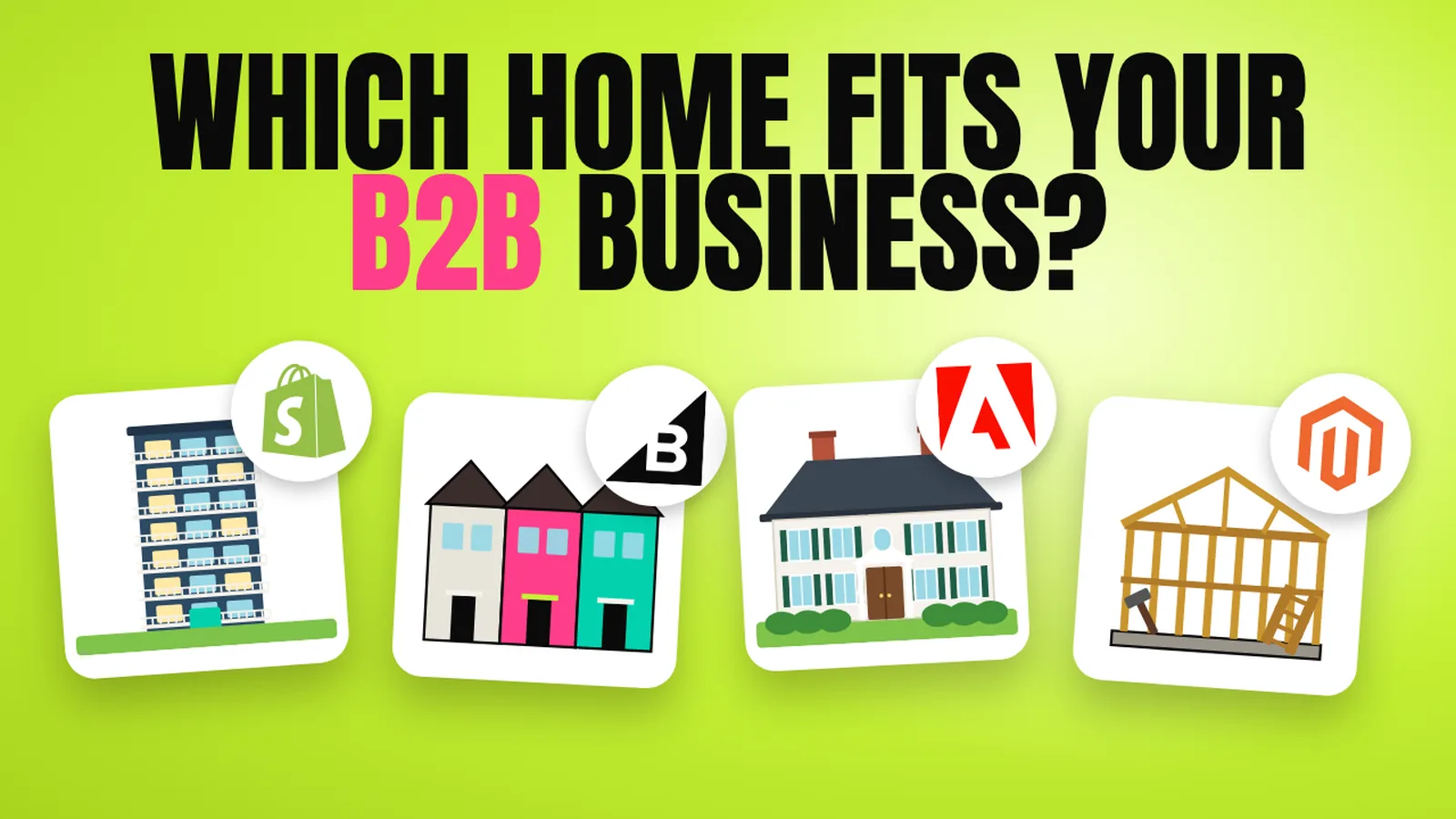
For B2B, Shopify Plus fits when you want to launch fast with light customization and a modest flow of ERP data. BigCommerce fits when quotes and buyer approvals run your business and you still don't want to run servers. Adobe Commerce fits when you have complex contract pricing and an ERP pushing data all day. Magento Open Source fits when you need full control on a smaller budget and have strong developers. The tiebreaker is the one thing no sales demo shows you: how much data your ERP pushes through the door.
This post is the written version of our video. We settle the question at a family Sunday dinner, where four relatives pitch four platforms. If you'd rather watch, it's about 14 minutes:
Want the wider field, including Salesforce, SAP, Oro and commercetools? See our B2B ecommerce platforms comparison.
Sunday dinner at the Brennans'
The Brennans are made up. Every argument at their table, we've heard from real clients.
The Brennans run Brennan Valve and Fitting, a third-generation business selling to plumbers, contractors and supply houses. Their website is older than the youngest grandkid, and it's time to replatform. At the head of the table sits Grandpa Sal, who started the company and still checks the fax tray every morning. His only question about ecommerce, ever: "Did anything come in on the fax?"
Around the table, four Brennans have four favorite platforms. Each one is a kind of home:
- Shopify is a condo. Easy to move into, low maintenance, everything done for you.
- BigCommerce is a townhome. More room to make it yours, but you don't own the whole building.
- Adobe Commerce is the mansion. You can customize everything. You also pay for all the upkeep.
- Magento Open Source is the house you build yourself, on the same foundation as the mansion. Free to use. All the work is yours.
The water line: why your ERP decides more than features do
Every B2B business has an ERP, the back-office system that knows your prices, stock, customers and invoices. Your website has to stay in sync with it all day, and they stay in sync through an API.
Think of the API as the water line between your ERP and your website. Every price change and every order is water running through it. A small business runs a little water. A distributor with a giant catalog and prices that change every hour runs a fire hose. And some homes put a limit on how much water you can run.
Shopify Plus for B2B: the condo
Nora runs sales, and she wants the condo. "We could launch fast. Nobody has to babysit servers. And checkout just works."
She's right. Shopify handles hosting, security and updates, and more B2B is built in than most people think:
- Regular Shopify plans: company accounts, net payment terms, volume pricing and quick order, with up to three active catalogs.
- Shopify Plus: unlimited catalogs, plus deposits and partial payments.
- Price: Plus starts at $2,300 a month on a three-year term, and bigger businesses pay an added fee based on sales.
The water line. The condo has a meter. Shopify measures every API call by how much work it asks for, and Plus gets ten times the per-second allowance of a standard store. That's plenty for most stores, and maybe not for a fire hose. Each app on the store gets its own meter, so the shipping app never steals the ERP's water. For really big jobs, Shopify has bulk operations, which work like a tanker truck that fills your tank overnight without the normal meter.
The rules. You can't move the walls. Customer-requested quotes and multi-step approvals usually mean adding an app.
The condo fits when you want to get off the ground fast, you don't need heavy customization, and you don't have a fire hose of data. More on this in our Shopify Plus for B2B guide and our Shopify Plus agency services.
BigCommerce for B2B: the townhome
Carol is the CFO, and she wants the townhome. "Half our orders start with a quote. And I want our customers' junior buyers to need approval before they spend our customers' money."
She's right too. BigCommerce's B2B Edition gives you company accounts, a buyer portal, quotes, purchase orders, invoices and price lists. It also has buyer roles, where a junior buyer builds a shopping list and a senior buyer approves it.
The townhome still has a landlord who handles hosting and security, but you can customize more than in the condo. You just can't tear out the load-bearing walls, because you don't own the core code.
The fine print. B2B Edition comes on BigCommerce's top plan, called Performance, which starts around $1,500 a month billed annually. B2B Edition is quoted on top.
The water line. The townhome has one meter for the whole unit, shared by every app on the store. On B2B Edition you're on Performance, where your limit is set by your plan, and some of the biggest stores get no set rate limit at all. Land one of those plans and you've got more water than any condo. But if the shipping app is running the dishwasher, the ERP gets a weaker shower.
The townhome fits when quotes and approvals matter, you want more control than a condo, and you still don't want to run servers. Compare the two hosted options head to head in Shopify Plus B2B vs BigCommerce B2B Edition, or see our BigCommerce B2B work.
Adobe Commerce for B2B: the mansion
Mike runs operations, and he wants the mansion. "We've got contract pricing for 400 accounts, an ERP that's been customized for 20 years, and prices that change every day."
Adobe Commerce is the full enterprise system. You can build anything, and many of the B2B rooms come on the blueprint:
- Company accounts with roles
- Shared catalogs with company-specific pricing
- Negotiable quotes
- Purchase orders with approval rules, so the big orders go to the boss and the small ones go straight through
The water line. In the mansion, you have your own well. Adobe Commerce has no per-plan cap on API calls. The ceiling is the servers you pay for. Need a bigger pipe? Put in a bigger pump.
That's the dividing line. If your ERP is pushing and pulling a lot of data all day, the hosted platforms can hit their limits. In the mansion, the limits are yours.
The upkeep. Somebody has to maintain the well: hosting, upgrades, security patches and developers. Adobe quotes pricing based on revenue. Adobe now also offers a version it runs for you, called Adobe Commerce as a Cloud Service, but switching to it is a real project (here's how it compares to Adobe Commerce on Cloud).
The mansion fits when you have complex B2B rules, heavy ERP traffic and a partner to maintain it. See our Adobe Commerce B2B work.
Magento Open Source for B2B: build it yourself
Cousin Danny is a developer, and he wants to build the house himself. "It's free. Same foundation as the mansion. Same private well. We can customize everything, and we don't pay a license."
Danny's not wrong. Magento Open Source gives you full control and no per-plan cap on data, and customer group pricing and tier pricing are built in.
The honest part. Company accounts, shared catalogs and quotes don't come in the box. You add them with extensions or custom work. And you host it, patch it and maintain it. Forever.
The self-built house fits when you need full customization and lots of data moving, on a smaller budget, with strong developers in house or through a partner. For the details, read Magento Open Source vs Adobe Commerce and see our Magento B2B solutions.
Shopify Plus vs BigCommerce vs Adobe Commerce vs Magento: side by side
| Shopify Plus | BigCommerce (B2B Edition) | Adobe Commerce | Magento Open Source | |
|---|---|---|---|---|
| The home | Condo | Townhome | Mansion | Build it yourself |
| Who hosts it | Shopify | BigCommerce | You (or Adobe's cloud service) | You |
| Built-in B2B | Company accounts, net terms, volume pricing, quick order, unlimited catalogs, deposits, partial payments | Company accounts, buyer portal, quotes, purchase orders, invoices, price lists, buyer roles | Company accounts with roles, shared catalogs, negotiable quotes, purchase orders with approval rules | Customer group and tier pricing (the rest via extensions) |
| Quotes and approvals | Usually an app | Built in | Built in | Extensions or custom work |
| API water line | Metered; Plus gets 10x a standard store; each app has its own meter; bulk operations for big jobs | One meter shared by every app; set by your plan, some of the biggest stores get no set limit | No per-plan cap; the ceiling is your servers | No per-plan cap; the ceiling is your servers |
| Customization | Can't move the walls | More than the condo, can't touch core code | Everything | Everything |
| Starting price | $2,300/mo on a 3-year term, plus a sales-based fee for bigger businesses | About $1,500/mo billed annually for Performance, B2B Edition quoted on top | Quoted by Adobe based on revenue | No license; you pay for hosting, upkeep and developers |
| Fits when | Fast launch, light customization, modest data | Quotes and approvals matter, no servers to run | Complex pricing, heavy ERP traffic, a partner to maintain it | Full control on a smaller budget with strong developers |
Pricing and limits change. Check each vendor's current terms before you sign, or bring your numbers to a Platform Selection Consultation and we'll walk through them with you.
A note for global giants. If you're already running SAP or Salesforce, or you have a big engineering team, also look at SAP, Salesforce and commercetools. The Brennans are not that. The Brennans have one IT guy, and it's Danny.
So who wins? The 3 questions that decide it
Nobody wins, and that's the point. Every Brennan was right about some business, just not always about this one. Here's how we'd decide:
- How much do you need to customize?
- How much water runs through the line? In other words, how much data moves between your ERP and your website, and how often your prices change.
- Who's maintaining the house? Your team, a partner, or the platform.
For the Brennans, the answers were a lot, a fire hose and a partner. Prices change daily across 400 accounts. That's Mike's mansion, Adobe Commerce, for the wholesale business.
But Nora had a surprise: a small consumer line for homeowners, with a simple catalog, light data and a need to go live fast. That's the condo. She can start on a regular Shopify plan and move up to Plus if it takes off. Two businesses, two homes.
And Carol? If the Brennans' prices changed once a week and quotes were the whole business, Carol's townhome would have won. If they were half the size with Danny full time, Danny's house would have been the smart money. Same table, different business, different answer.
The real fax machine story
This part is true. We worked with a wholesaler whose product updates arrived on a fax machine. Every day, pages and pages. Nobody could type fast enough to keep the website current.
So we turned the faxes into data and set up a daily upload. Hundreds of thousands of products were added, and it dramatically increased that wholesaler's business.
That's the job most platform decisions skip: getting the data out of the back office and into the website, every day, without anyone retyping it. It's why we put the ERP integration at the center of every platform choice.
Frequently asked questions
Which is the best B2B ecommerce platform: Shopify Plus, BigCommerce, Adobe Commerce or Magento?
None of them is best for every business. Shopify Plus fits a fast launch with light customization and modest ERP data. BigCommerce B2B Edition fits quote-heavy businesses that want built-in approvals without running servers. Adobe Commerce fits complex contract pricing and heavy ERP traffic. Magento Open Source fits full customization on a smaller budget with strong developers.
Does Shopify Plus support B2B quotes and approvals?
Shopify Plus includes company accounts, net payment terms, volume pricing, quick order, unlimited catalogs, deposits and partial payments. Customer-requested quotes and multi-step approvals usually mean adding an app.
Is BigCommerce B2B Edition included in every BigCommerce plan?
No. B2B Edition comes on BigCommerce's top plan, Performance, which starts around $1,500 a month billed annually, and B2B Edition is quoted on top.
Do Shopify and BigCommerce limit API calls from my ERP?
Both hosted platforms meter API calls. Shopify measures each call by how much work it asks for, gives Plus ten times a standard store's allowance, gives every app its own meter and offers bulk operations for large jobs. BigCommerce uses one limit shared by every app on the store, set by your plan, and some of the largest stores get no set limit. Adobe Commerce and Magento Open Source have no per-plan cap; the limit is the servers you pay for.
What's the difference between Adobe Commerce and Magento Open Source for B2B?
They share the same foundation. Adobe Commerce adds B2B features like company accounts with roles, shared catalogs, negotiable quotes and purchase order approval rules, with pricing quoted by Adobe based on revenue. Magento Open Source is free to use and includes customer group and tier pricing, but company accounts, shared catalogs and quotes need extensions or custom work, and you host and maintain it yourself.
Get help picking the right home
We're platform agnostic. We build mostly on Adobe Commerce and Magento, Shopify and BigCommerce, and we can work on any platform. We help you pick, build it and connect it to your ERP, like Warner Press, running Magento connected to a Sage ERP, and Europa Eyewear, selling wholesale, retail and on marketplaces.
Want a head start? Grab the free Platform Comparison and ROI Calculator and fill in what you know. Then book a Platform Selection Consultation. It starts with a 30-minute assessment, then we go through more than 130 requirements and real pricing for your business and tell you which home fits.
And tell us: which Brennan are you?