Last updated: May 24, 2026 · 17 min read · By Joe McFerrin, CEO of IWD Agency
NetSuite integration is the single largest scope variable on any B2B ecommerce build. Connect it cleanly and customer-specific pricing, inventory, and order workflows happen automatically. Connect it badly — or skip the integration entirely — and your sales team spends 30 hours/week on manual order entry that should have been automated.
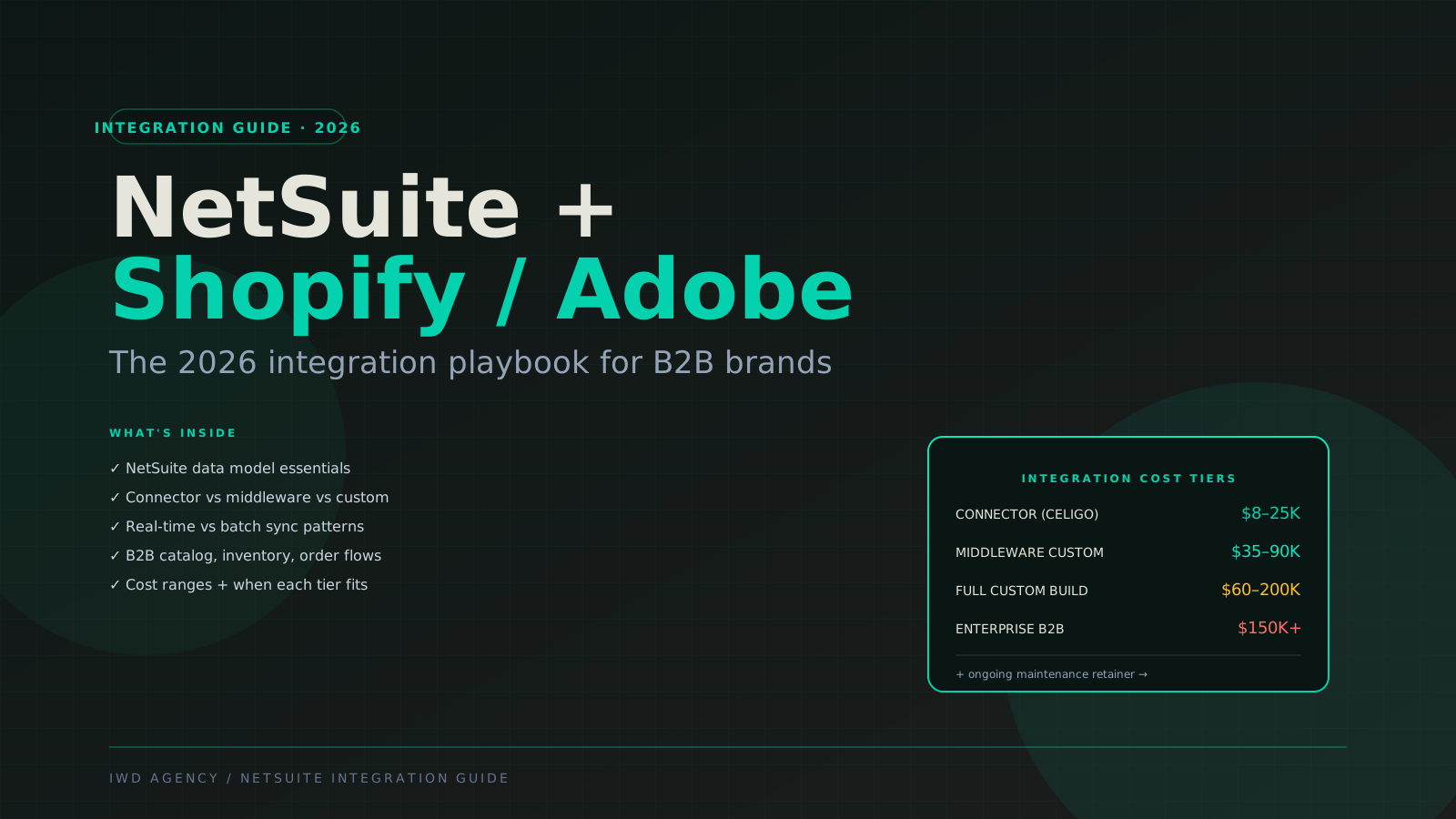
This guide is the architectural framework our team uses on every NetSuite integration scoping call. It covers the data model essentials, the three integration tiers (connector / middleware / custom), real-time vs batch sync patterns, B2B catalog and inventory flows, realistic cost ranges, and the decision framework for picking the right integration depth for your scale. For storefront-only projects that fit Tier 1, IWD also builds Dominate, a NetSuite connector for Shopify, Magento, and BigCommerce, priced from $99 per month.
If you're evaluating ecommerce platforms with NetSuite already in place, pair this with our Best Adobe Commerce Agencies 2026 and Shopify Plus vs Adobe Commerce 2026 guides.
The 30-Second Verdict
| Your situation | Recommended integration tier |
|---|---|
| Sub-2M GMV, simple B2B catalog | Pre-built connector (Celigo, Boomi) — $8-25K |
| 2-10M GMV, moderate customization | Middleware (Celigo + custom logic) — $35-90K |
| 10M+ GMV, complex B2B catalogs + pricing | Custom integration build — $60-200K |
| 25M+ GMV, real-time inventory + multi-warehouse | Enterprise custom — $150K+ |
| You already have NetSuite SuiteCommerce | Replatform first, then integrate — see our Magento to Adobe Commerce migration guide |
Key insight: integration cost typically equals 30-50% of the storefront build cost. If your Adobe Commerce or Shopify Plus build is $150K, expect NetSuite integration to be $45-75K minimum. Don't underbudget this line.
NetSuite Data Model Essentials
Before scoping any integration, understand what's flowing between systems. NetSuite acts as the system of record for most B2B data:
| Object | Lives in NetSuite | Syncs to ecommerce | Direction |
|---|---|---|---|
| Customer accounts (companies, contacts) | ✓ | ✓ | Bidirectional |
| Customer-specific pricing tiers | ✓ | ✓ | NetSuite → Ecommerce |
| Product catalog (SKUs, descriptions) | ✓ | ✓ | NetSuite → Ecommerce |
| Inventory (multi-warehouse, available, committed) | ✓ | ✓ | NetSuite → Ecommerce (real-time critical) |
| Customer-specific catalogs | ✓ | ✓ | NetSuite → Ecommerce |
| Sales orders | ✓ | ✓ | Ecommerce → NetSuite |
| Payments + invoices | ✓ | Partial | NetSuite → Ecommerce (status only) |
| Tax + shipping rules | ✓ | ✓ | NetSuite → Ecommerce |
| Net terms + credit limits | ✓ | ✓ | NetSuite → Ecommerce |
| Shipping methods + carriers | ✓ | ✓ | NetSuite → Ecommerce |
| Promotions + discounts | Sometimes | ✓ | Varies |
| CMS / blog content | — | ✓ | Ecommerce-only |
| SEO metadata | — | ✓ | Ecommerce-only |
The single most important rule: NetSuite is authoritative for B2B data. If a price conflict exists between NetSuite and the storefront, NetSuite wins. The ecommerce platform is a display + transaction surface; NetSuite is the operational system.
Three Integration Tiers
The integration depth determines cost, capability, and operational complexity. Pick the right tier for your scale.
Tier 1 — Pre-built Connector ($8K-$25K)
What it is: A connector platform (Celigo, Boomi, Jitterbit) ships with pre-built integration templates for NetSuite + Shopify, NetSuite + Adobe Commerce, NetSuite + BigCommerce. Your agency installs the connector, maps your fields, configures sync frequency, tests, deploys.
Sync pattern: Batch every 5-15 minutes for most data; real-time webhooks for orders.
Best for: Brands with relatively standard NetSuite configurations. If your business logic fits the connector's assumptions (standard customer tiers, standard pricing models, single warehouse), this tier delivers 80% of the value at 20% of the cost.
Limits: Custom field mappings are awkward. Business rules that don't fit the connector's design require external scripting. Real-time isn't reliable for inventory at high transaction volume.
Tier 2 — Customized Middleware ($35K-$90K)
What it is: Same connector platform (typically Celigo) plus custom integration scripts that handle your specific business rules. The connector handles common patterns; your custom layer handles edge cases.
Sync pattern: Bi-directional, with real-time for orders + inventory + pricing changes, batch for catalog + customer data.
Best for: Brands at 2-10M GMV with moderately customized NetSuite setups. Common scenarios: customer-specific catalogs that aren't natively supported, multi-warehouse inventory rollup, custom pricing logic beyond standard tier pricing, complex tax rules.
Limits: Middleware adds a moving part (your Celigo/Boomi subscription) plus a vendor relationship. Adds operational complexity to debugging.
Tier 3 — Custom Integration Build ($60K-$200K+)
What it is: Agency writes a fully custom integration using NetSuite's REST/SOAP APIs and the ecommerce platform's APIs directly. No middleware vendor; no connector layer.
Sync pattern: Real-time bi-directional for everything that matters (orders, inventory, pricing, customer changes). Batch fallback for catalog refresh.
Best for: Brands at 10M+ GMV with deeply customized NetSuite configurations OR brands where the integration is a competitive advantage (e.g., real-time multi-warehouse inventory across 10+ regions).
Limits: Highest cost. Your agency becomes the integration vendor — replacing them later is a real cost. Choose your integration agency carefully.
Real-Time vs Batch Sync — When Each Matters
Not every data point needs real-time sync. Picking the right cadence for each field saves significant cost.
| Data point | Real-time critical? | Why |
|---|---|---|
| Inventory (stock levels) | ✅ Yes | Customer ordering out-of-stock SKU = bad CX |
| Orders (storefront → NetSuite) | ✅ Yes | Fulfillment SLA depends on speed |
| Order status (NetSuite → storefront) | ✅ Yes | Customer expects "shipped" notification quickly |
| Customer-specific pricing | ✅ Yes if dynamic | If account manager updates pricing in NetSuite, customer sees it on next page load |
| Customer accounts (new + updates) | ⚠️ Soft yes | Same-day sync is usually adequate |
| Product catalog (new SKUs, descriptions) | ❌ No | 1-hour batch is usually fine |
| Tax + shipping rules | ❌ No | Daily batch is plenty |
| Order history backfill | ❌ No | One-time batch import during migration |
The real-time-vs-batch decision is a cost lever. Tier 1 connectors handle batch well; real-time requires Tier 2 middleware or Tier 3 custom.
B2B Catalog + Inventory Flow Patterns
For B2B brands, the catalog + inventory integration is where most complexity lives. Three common patterns:
Pattern A — Single Catalog, Customer-Specific Pricing
Use case: All customers see the same products but pricing varies by customer tier.
Integration approach:
- NetSuite ships single product catalog
- NetSuite ships customer pricing tiers (Tier 1, Tier 2, Tier 3, etc.)
- Ecommerce platform applies the right tier on login
Fits: Adobe Commerce native B2B, Shopify Plus B2B with company accounts, BigCommerce B2B Edition.
Cost: Tier 1 connector ($8-25K) typically sufficient.
Pattern B — Customer-Specific Catalogs
Use case: Different customers see entirely different products (sometimes restricted by contract, sometimes by exclusive distribution rights).
Integration approach:
- NetSuite ships master catalog
- NetSuite ships per-customer catalog assignments
- Ecommerce platform filters catalog view by customer assignment
Fits: Adobe Commerce native B2B handles this best. Shopify Plus B2B requires extension or middleware logic. BigCommerce B2B Edition supports this natively.
Cost: Tier 2 middleware ($35-90K) typically required.
Pattern C — Multi-Warehouse Inventory with Allocation Rules
Use case: Inventory across 5-50+ warehouses, each customer sees stock allocated to their region or assigned warehouse.
Integration approach:
- NetSuite ships per-warehouse inventory in real-time
- Ecommerce platform displays "available" stock = sum across customer-assigned warehouses
- Order routing logic decides which warehouse ships each line item
Fits: Adobe Commerce + custom integration. Shopify Plus with apps (limits at scale). BigCommerce B2B Edition handles multi-warehouse natively.
Cost: Tier 3 custom ($60-200K+) typically required.
Common Integration Pitfalls
Pitfall #1 — Underestimating field mapping complexity
NetSuite has ~3,000+ standard fields plus your custom fields. Real integration scoping requires a field-by-field mapping spreadsheet during planning. Skip this and discover at week 8 of build that a field your sales team uses for order routing doesn't have a target field on the ecommerce side.
Pitfall #2 — Treating inventory sync as "set and forget"
Inventory is the highest-stakes sync. Tax engines and tier pricing are computed; inventory is the source of truth. Test inventory sync under load. Validate edge cases: what happens when a NetSuite write fails mid-sync? What if the API rate limits? Plan failover behavior.
Pitfall #3 — Not budgeting for ongoing maintenance
Integration breaks. NetSuite pushes a SuiteBundle update; the ecommerce platform releases a major version; an API endpoint deprecates. Budget $1-5K/month in retainer specifically for integration maintenance separate from your storefront retainer.
Pitfall #4 — Real-time fantasy where batch is fine
"Real-time everything" sounds great but multiplies cost. Be honest about which fields actually need real-time. Most don't.
Pitfall #5 — Skipping the staging environment
Integration testing requires a NetSuite sandbox. Skipping this means testing in production = real risk. Adobe and Shopify both make staging environments easy; NetSuite sandbox provisioning takes weeks. Budget for it during planning.
Cost by Scenario
Real ranges from client quotes we've seen:
| Scenario | Tier | Cost |
|---|---|---|
| Small B2B (sub-2M), standard NetSuite config, Adobe Commerce or Shopify Plus | Tier 1 | $8-25K |
| Mid-market B2B (2-10M), moderate customization, Adobe Commerce | Tier 1 or Tier 2 | $25-75K |
| Mid-market B2B with custom catalogs (5-15M) | Tier 2 | $50-100K |
| Enterprise B2B (10-25M), multi-warehouse, real-time inventory | Tier 2 or Tier 3 | $80-180K |
| Large enterprise (25M+), complex B2B with custom workflows | Tier 3 | $150-300K |
| Replatform with full integration redesign | Tier 3+ | $200K-500K+ |
Ongoing retainer: $1-5K/month for integration maintenance. Budget separately from storefront retainer.
For the broader Adobe Commerce + NetSuite integration framework with IWD's in-house NetSuite Connector, see our Magento NetSuite integration guide. For pricing context on the broader stack, see the Adobe Commerce Pricing 2026 guide.
Frequently Asked Questions
Common questions about NetSuite integration
Do I need NetSuite to do B2B ecommerce?
No. B2B ecommerce works on any platform without NetSuite. NetSuite becomes valuable when you have complex operations — multi-warehouse, customer-specific catalogs, customer-specific pricing tiers at scale, real-time inventory. Below 2M GMV with simple operations, the NetSuite license cost ($1,000-5,000/user/month) often exceeds the operational savings.
Which connector is best — Celigo, Boomi, or Jitterbit?
Celigo dominates Magento/Adobe Commerce + NetSuite integration. Their Integrator.io connector has been a Magento Marketplace fixture for years. Boomi has strong Salesforce + NetSuite integration patterns. Jitterbit is solid but smaller user base for ecommerce-specific integration. For most Adobe Commerce or Shopify Plus + NetSuite projects, Celigo is the default starting point.
Can I integrate NetSuite with Shopify Plus?
Yes — well. Shopify Plus + Celigo is a mature integration pattern. Native multi-warehouse inventory in Plus is more limited than Adobe Commerce, so brands with 10+ warehouses sometimes hit ceilings that require Tier 3 custom integration. For most mid-market B2B, Shopify Plus + Celigo handles 90% of NetSuite integration needs.
How long does NetSuite integration take?
Tier 1 connector: 2-6 weeks. Tier 2 middleware: 6-14 weeks. Tier 3 custom: 12-24 weeks. Add 2-4 weeks for thorough testing including edge cases. Typically runs in parallel with the storefront build during last 30-50% of the project timeline.
What if my NetSuite is heavily customized?
You're likely Tier 2 or Tier 3. Pre-built connectors assume standard NetSuite configurations. Heavy customization (custom record types, custom field naming, custom workflows) breaks the connector's assumptions. Budget for custom integration logic. Plan a discovery phase where your integration agency maps every custom field/workflow before scoping.
What's NetSuite SuiteCommerce vs integrated ecommerce?
NetSuite SuiteCommerce is Oracle's ecommerce platform built on top of NetSuite. Pros: zero integration needed since everything is NetSuite. Cons: limited frontend flexibility, smaller agency ecosystem, weaker DTC capability than Shopify Plus or Adobe Commerce. Most brands at 5M+ GMV move from SuiteCommerce to Shopify Plus + Celigo or Adobe Commerce + Celigo for better frontend + larger talent pool.
Should I use Adobe Commerce or Shopify Plus with NetSuite?
Adobe Commerce wins for complex B2B + NetSuite scenarios. Native B2B + deeper API surface + on-prem deployment make complex integration easier. Shopify Plus wins for simpler B2B + faster time-to-market. For most mid-market B2B brands, either platform integrates with NetSuite acceptably — pick the platform that fits your operational complexity first, then integrate NetSuite.
What's the cost of a botched integration?
Real cost is operational, not engineering. A bad integration means manual order entry (15-30 hrs/week of CSR labor), inventory accuracy issues (oversold SKUs, dropped orders), and pricing errors (wrong customer pricing applied). The hidden cost of a botched integration typically exceeds the cost of doing the integration properly in the first place by 3-5x within 12 months.
Do I need a separate integration agency vs my ecommerce agency?
Sometimes yes. Many ecommerce agencies don't have deep NetSuite expertise. Some do. IWD ships ~20 NetSuite integrations per year and our team built the Dominate NetSuite connector (see the Dominate Magento NetSuite connector) and offers NetSuite integration services for the custom work around it. If your ecommerce agency doesn't have demonstrable NetSuite case studies, bring in a specialized NetSuite integration partner for the integration work.
What about other ERPs — SAP, Microsoft Dynamics, Acumatica?
Same integration tiers apply. Connector platforms (Celigo, Boomi, Jitterbit) all support multiple ERPs. SAP integration is typically more expensive than NetSuite at the same complexity tier — SAP's data model has more edge cases. MS Dynamics and Acumatica fall in the same cost range as NetSuite. The architectural framework in this guide applies to any ERP-to-ecommerce integration project.
Related Reading
Magento NetSuite Integration Guide · Magento B2B agency · NetSuite integration services · Dominate Adobe Commerce NetSuite integration · Best Adobe Commerce Agencies in 2026 · Adobe Commerce Pricing 2026
If you're scoping a NetSuite integration project, book a 30-minute integration assessment. Our team has shipped 200+ NetSuite integrations since 2010 across Shopify Plus, Adobe Commerce, BigCommerce, and Magento Open Source — we'll walk through fit honestly including which tier matches your operational complexity.