Last updated: May 24, 2026 · 18 min read · By Joe McFerrin, CEO of IWD Agency
Migrating from Magento to Adobe Commerce is the most common replatform engagement our team scopes in 2026. Magento 1 has been end-of-lifed since June 2020, no security patches, no compatibility with modern PHP versions, no third-party extension updates. Brands still on M1 in 2026 are carrying real risk on every revenue-generating transaction. This playbook is the same one our Adobe Commerce agency team uses on client migrations.
This guide is the comprehensive 2026 playbook covering: why M1 EOL matters operationally, the choice between Magento Open Source 2 and Adobe Commerce, realistic migration cost and timeline brackets, data continuity checklist, custom code refactoring strategy, and the 8 most common pitfalls we see kill migration projects.
If you're also evaluating Shopify Plus or BigCommerce as the migration destination, pair this with our Shopify Plus vs Adobe Commerce 2026 and Best Adobe Commerce Agencies in 2026 guides.
The 30-Second Verdict
| Your situation | Recommended path |
|---|---|
| On Magento 1 (any version) | Migrate to Adobe Commerce 2 within 6-12 months |
| On Magento 2 Open Source, sub-2M GMV | Stay on M2 Open Source, keep current |
| On Magento 2 Open Source, 2-10M GMV with B2B | Upgrade to Adobe Commerce 2 for native B2B |
| On Magento 2 Open Source, 10M+ GMV | Upgrade to Adobe Commerce 2 for support + B2B |
| On Adobe Commerce 2 (current) | Stay current, apply patches every quarter |
| Considering switching platforms entirely | Read our Shopify Plus vs Adobe Commerce 2026 comparison first |
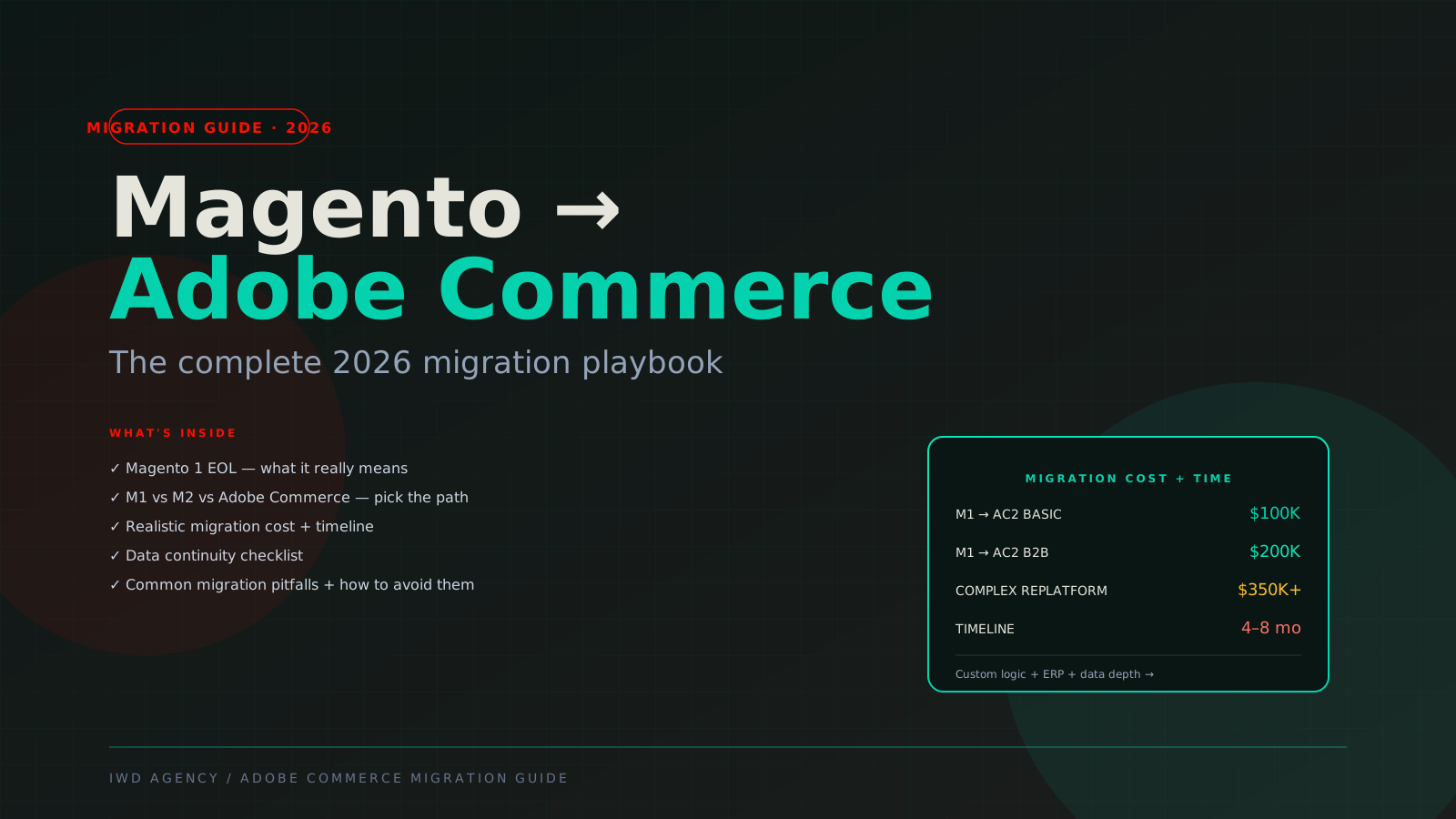
Migration cost reality: $100K (basic M1→AC2) to $350K+ (complex replatform with B2B + ERP integration). Timeline: 4-8 months for most engagements.
Why Magento 1 EOL Actually Matters
Magento 1 was officially end-of-lifed by Adobe on June 30, 2020 — over 5 years ago at this point. Brands still running M1 in 2026 face real operational risks beyond "Adobe isn't maintaining it":
| Risk | Impact |
|---|---|
| No security patches | Every new vulnerability stays exploitable. PCI compliance becomes harder to defend. |
| PHP version compatibility | M1 doesn't run on modern PHP 8.x cleanly. Hosting providers are dropping PHP 7.x support. |
| Third-party extensions stale | Most M1 extension authors stopped releasing updates in 2020-2022. |
| Payment gateway deprecation | Some gateways (and some PCI-DSS standards) no longer certify M1 stores. |
| Browser compatibility drift | M1's older frontend assumptions break on modern mobile browsers. |
| Hosting cost pressure | Quality M1 hosting becomes rare; remaining providers charge premium. |
| Talent availability | Senior M1 developers have largely moved to M2/Adobe Commerce or Shopify. Cost of M1-specific work has tripled since 2020. |
The TLDR: every month longer on Magento 1 is operationally more expensive than the previous month. The migration cost is real but the cost of staying is rising on a curve.
M2 Open Source vs Adobe Commerce — Pick the Right Destination
Once you've decided to leave M1, the next decision is: migrate to free Magento Open Source 2, or pay for Adobe Commerce 2?
| Feature | Magento Open Source 2 (free) | Adobe Commerce 2 ($22K+/yr) |
|---|---|---|
| Core Magento codebase | ✓ Same | ✓ Same |
| Native B2B (companies, catalogs, quotes) | — Via extensions | ✓ Native |
| Page Builder | — Limited | ✓ Full |
| Advanced staging + preview | — | ✓ |
| Adobe support | — Community only | ✓ Adobe team |
| Security patches | ✓ Same cadence | ✓ Same cadence |
| Performance + scalability | ✓ Same | ✓ Same |
| Hosting | You arrange | Self-host OR Adobe Commerce Cloud |
| Dedicated account manager | — | ✓ |
| Magento Business Intelligence | — | Add-on |
Pick Magento Open Source 2 if: Sub-2M GMV, simple DTC, no B2B requirements, in-house technical team capable of managing operations.
Pick Adobe Commerce 2 if: Any B2B requirements (the native B2B alone saves $30-60K in third-party extension development), 5M+ GMV with operational complexity, or you want Adobe support for mission-critical uptime.
For deep cost analysis, see our Adobe Commerce Pricing 2026 breakdown.
Migration Cost + Timeline by Complexity
Here's the realistic 2026 pricing for Magento → Adobe Commerce migration projects, based on real client quotes we've scoped:
| Migration type | Cost | Timeline | Risk |
|---|---|---|---|
| M1 → M2 Open Source (basic catalog migration) | $75K-150K | 4-6 months | Low |
| M1 → Adobe Commerce 2 (basic) | $100K-180K | 4-7 months | Low |
| M1 → Adobe Commerce 2 (with B2B configuration) | $150K-250K | 6-9 months | Medium |
| M1 → Adobe Commerce 2 (with ERP integration) | $200K-350K | 7-10 months | Medium |
| Complex replatform (M1 + heavy customization + ERP + B2B) | $300K-500K+ | 8-12 months | High |
| Sap Hybris / SFCC → Adobe Commerce 2 | $250K-750K | 9-14 months | High |
Variables that move cost:
- Custom code volume on M1. A vanilla M1 store with mostly default behavior migrates cheap. A heavily customized M1 with 30+ custom modules will cost 2-3x more because every module needs to be rewritten for M2 architecture.
- Catalog size. 5K SKUs is straightforward. 50K SKUs adds data engineering work. 500K SKUs requires custom migration tooling and validation.
- Order history retention. Migrating live orders + customer accounts adds 2-4 weeks vs. starting fresh.
- ERP integration. Every named ERP integration adds $40-90K depending on depth.
- Custom checkout logic. If your M1 store has heavy checkout customization (tax engines, regional shipping rules, payment routing), expect 4-8 weeks of additional checkout work.
- Headless / PWA Studio. Adds $60-150K and 6-12 weeks above headed migration.
The 6-Stage Migration Process
Stage 1: Audit (2-4 weeks)
Comprehensive audit of your current Magento store:
- Code audit: Inventory all custom modules, third-party extensions, theme customizations. Identify which can be replaced with Adobe Commerce native features (often 30-50% of M1 customizations become unnecessary).
- Data audit: SKU counts, customer counts, order volume, attribute complexity, custom field usage.
- Performance baseline: Current page load, TTFB, lighthouse scores — to validate post-migration improvement.
- Integration mapping: ERP, PIM, OMS, marketing, analytics — every external system that touches Magento.
Stage 2: Plan (1-2 weeks)
Translate audit into engineering plan:
- Scope custom code rewrite vs. replace-with-native vs. defer
- Stage data migration approach (single-pass vs. incremental)
- Schedule integration cutover (ERP first or last)
- Define UAT criteria + sign-off gates
- Set timeline + budget with explicit assumptions
Stage 3: Build (10-16 weeks)
Build Adobe Commerce 2 from scratch in parallel with the live M1 store:
- Theme + design (often refresh vs. lift-and-shift)
- Custom modules — rewritten for M2 architecture
- Integrations — connected to staging
- Configuration — payment gateways, shipping, tax, etc.
Stage 4: Migrate Data (2-4 weeks)
Move historical data from M1 to AC2:
- Customer accounts with password preservation (where possible)
- Order history (typically last 2-7 years)
- Catalog data with attribute mappings
- Custom data sets
Stage 5: QA + UAT (3-5 weeks)
Validate everything works:
- Internal QA matrix
- Client UAT cycles
- Performance testing (load + stress)
- Soft launch with traffic ramp
Stage 6: Cutover (1-2 weeks)
Flip DNS:
- Final data sync from M1 (orders placed during late development phase)
- DNS cutover with monitoring
- 7-14 day "watch window" with old M1 store accessible as fallback
- Decommission M1 after stability confirmed
Data Continuity Checklist
The most common point where migrations go wrong: data integrity through the migration. Use this checklist on every project:
- Customer accounts — emails, names, addresses, password hashes (some hash formats can be preserved; others require forced password reset)
- Order history — orders, line items, customer-to-order linking
- Catalog — products, attributes, attribute sets, categories, hierarchical relationships
- Inventory — current stock levels, multi-warehouse mapping
- Pricing — base prices, customer-group pricing, tier pricing, sale schedules
- Content — CMS pages, blocks, static text
- Reviews + UGC — customer-submitted content
- Tax + shipping rules — regional configurations
- SEO metadata — title tags, meta descriptions, URL slugs
- 301 redirects — old M1 URLs to new AC2 URLs (most critical for SEO continuity)
- Sitemap submission — fresh sitemap.xml to Google Search Console + Bing Webmaster on cutover day
The 301 redirect map is the line item most agencies underestimate — losing SEO equity from URL changes can cost 6-18 months of recovery.
8 Common Migration Pitfalls
Pitfall #1 — Lift-and-shift instead of architectural reset
The most expensive mistake. Treating migration as a 1:1 port of M1 customizations preserves all the architectural debt that made M1 hard to maintain. Better: use the migration as a chance to identify which customizations are still necessary, replace what you can with Adobe Commerce native features (often 30-50%), and refactor the rest cleanly.
Pitfall #2 — Skipping the audit stage
"We know our store" — until the audit reveals 40 custom modules nobody documented and 12 third-party extensions still being used in checkout flow. Skip the audit, and scope blows out at week 12 of build.
Pitfall #3 — Underestimating SEO redirect map work
URL structures often change between M1 and AC2. Every changing URL needs a 301 redirect to preserve Google rankings. Brands that skip this lose 40-70% of organic traffic for 6-18 months. Budget 2-3 weeks of dedicated redirect-mapping work.
Pitfall #4 — Insufficient data validation in QA
"It looks right" is not data validation. Real validation: row-counts match between M1 and AC2 for every data set, sample customer accounts log in successfully, sample orders show correct totals + shipping + tax. Automated validation scripts should run nightly during build.
Pitfall #5 — Production cutover without rollback plan
If something breaks at 3am, you need a documented rollback path back to M1. Plan for it before cutover, document it, test it on staging. The cutover is the highest-risk hour in any migration.
Pitfall #6 — ERP integration as an afterthought
Brands often migrate Magento first and "integrate ERP after." Then discover real-time inventory sync isn't possible because data models diverged. ERP integration should be designed during plan stage and validated during QA.
Pitfall #7 — Custom checkout logic break
If your M1 store has heavy checkout customization (regional shipping rules, tax engines, payment routing), expect 4-8 weeks of dedicated checkout work in AC2 to reproduce equivalent behavior. Skipping this typically surfaces 1-2 weeks before cutover with no time to fix.
Pitfall #8 — Choosing the wrong agency
Cross-platform migrations are the hardest engagements an agency runs. Many "Adobe Commerce agencies" have shipped 50 fresh builds but only 2-3 actual M1→AC2 migrations. Get specific case studies. See our Best Adobe Commerce Agencies in 2026 guide — the methodology section ranks agencies specifically on migration track record.
Frequently Asked Questions
Common questions about Magento → Adobe Commerce migration
Do I have to migrate from Magento 1?
Practically, yes — within the next 6-18 months. Magento 1 has been end-of-lifed since June 2020. Security patches stopped. Hosting providers are dropping PHP 7.x support that M1 depends on. Every month longer on M1 increases operational risk and the cost of staying.
Can I do a partial migration in stages?
Generally no. Magento architecture doesn't support running M1 and M2 storefronts side-by-side on the same domain. Some brands run a staging M2 build in parallel with live M1, but cutover is still a single event for any given storefront. Multi-region brands can migrate regional storefronts in sequence (e.g., US first, EU 6 months later).
How long is a typical M1 → AC2 migration?
4-6 months for basic migrations. 6-9 months with B2B configuration. 7-10 months with ERP integration. 8-12 months for complex replatforms with heavy customization. These are agency-side timelines — your team will also need 2-3 person-months of effort on configuration, content prep, and UAT.
How much does Magento → Adobe Commerce migration cost?
$100K-$180K for basic M1 → AC2 with default features. $200K-$350K with B2B + ERP integration. $300K-$500K+ for complex replatforms with heavy customization. Add license cost ($22K+/yr for Adobe Commerce), hosting ($15-50K/yr), and ongoing dev retainer ($8-25K/mo).
Will I lose SEO rankings during migration?
Some short-term dips are normal; long-term losses are preventable. The single most important factor: 301 redirects from old M1 URLs to new AC2 URLs. With clean redirects, sitemap re-submission to Google Search Console + Bing Webmaster, and identical metadata, most brands recover to pre-migration organic traffic within 4-12 weeks.
What about Magento extensions I'm using?
Inventory them during audit. Many M1 extensions have M2/AC2 versions from the same author (typically requires repurchase). Some have been replaced by Adobe Commerce native features (free upgrade). Some have been abandoned entirely (needs custom development to replace). Budget $10-30K for extension replacement at typical scope.
Can I migrate my customer accounts and passwords?
Customer accounts yes. Passwords — partially. Magento password hashes can be migrated and used in AC2 without users re-creating accounts. Some hash formats are incompatible and require forcing a password reset on first login. The migration tool detects this and handles automatically.
Should I redesign during migration?
Usually yes — it's the cheapest time to do it. Adding a design refresh to migration adds ~$30-60K to project cost but saves doing it later as a separate engagement. Most brands also use migration as a chance to refresh frontend technology (move from M1 themes to AC2 native theme system or PWA Studio headless).
What's the fastest migration timeline possible?
3-4 months for basic catalog-only migrations of stores with minimal customization and clean data. Aggressive timeline requires waving QA standards, which compounds risk at cutover. Most healthy migrations land at 4-6 months minimum.
Should I consider Shopify Plus or BigCommerce as the destination instead?
Worth evaluating. Adobe Commerce wins for complex B2B + ERP-heavy stores. Shopify Plus wins for simpler DTC stores at any scale. BigCommerce Enterprise sits in between with strong native B2B. Read our Shopify Plus vs Adobe Commerce 2026 comparison and Shopify Plus B2B vs BigCommerce B2B before deciding.
Related Reading
IWD Adobe Commerce development services · Adobe Commerce Pricing 2026 · Best Adobe Commerce Agencies in 2026 · Shopify Plus vs Adobe Commerce 2026 · Magento NetSuite Integration Guide
If you're scoping a Magento → Adobe Commerce migration, book a 30-minute migration assessment. As a Magento migration company that has shipped 60+ migrations since 2010, we'll walk through your specific situation honestly, including whether Shopify Plus or BigCommerce might be a better destination for your use case.
Work with IWD
Planning the move? Our senior team migrates you without losing catalog, customers, orders, or SEO equity. Explore our Magento data migration services, Adobe Commerce migration, Magento B2B agency, and Magento development services.